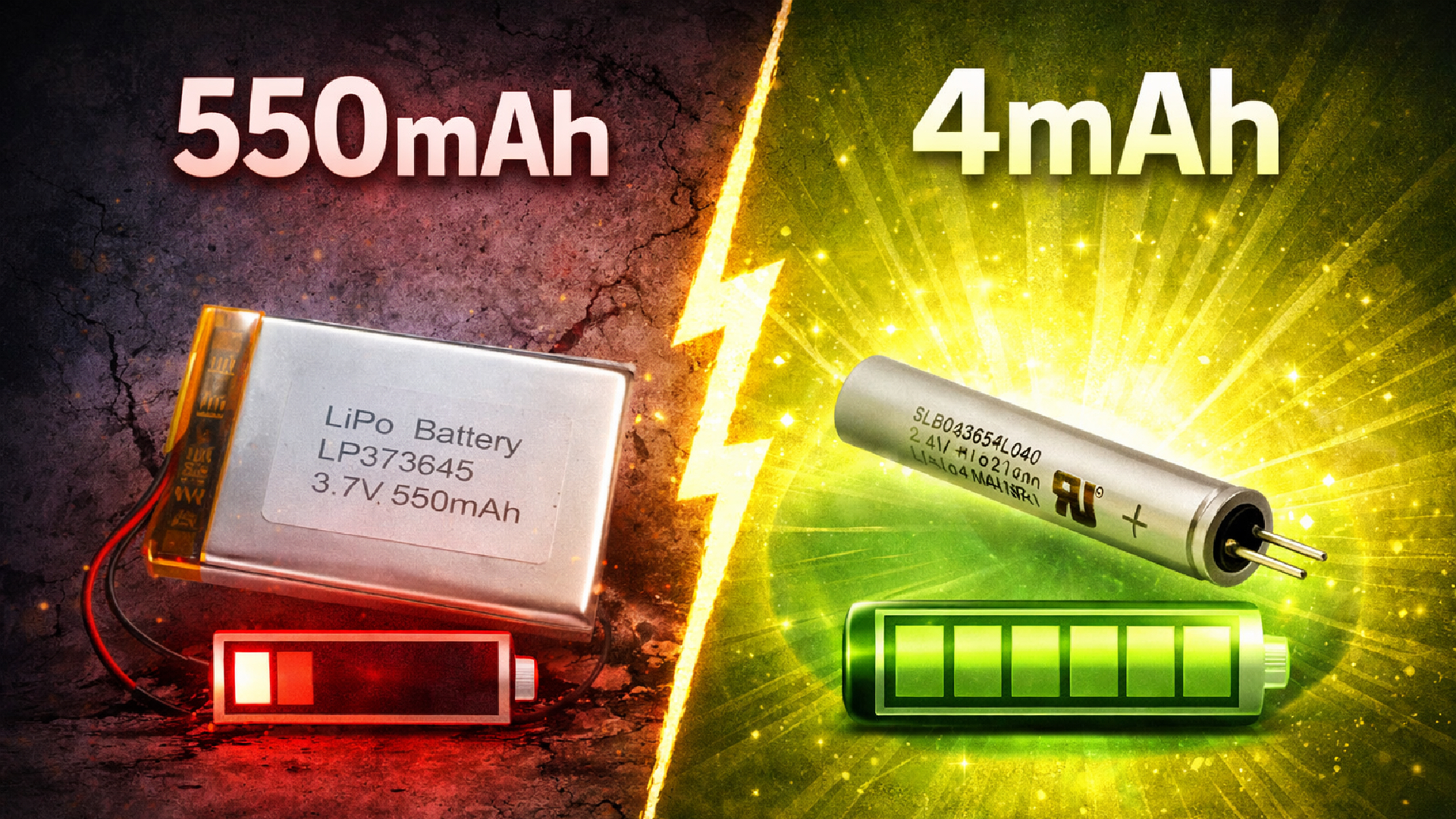

There’s a moment every engineer recognises, when a “simple” product fails for an annoyingly non-technical reason. In our case it was a restaurant pager that kept dying at the worst possible time. Not because it lacked capacity, but because it could not charge fast enough between uses. So instead of throwing a bigger battery at the problem, we rebuilt the system around Nichicon LTO batteries and a custom charging and protection circuit that actually matches the real-world duty cycle.
The core problem: recharge rate, not runtime
Most pager systems are built around LiPo. They look fine on paper, plenty of milliamp-hours, decent voltage, easy integration. Then a busy service hits, pagers discharge, get dropped back on charge, and never fully recover before the next round. Over time, they spiral down until someone is stood at the counter, hungry, with a silent brick in their hand.
That is why C-rate matters more than capacity in this specific use case. With Nichicon LTO batteries, the headline is not “how long does it run”, it’s “how quickly can it get back in the game”. Fast charging changes the entire system behaviour. The pager can be topped up in the short gaps that actually exist in a real restaurant workflow.
The build: a custom power path you can copy
We had three weeks before CES. That meant no “nice-to-have” features, just a clean architecture and a repeatable reference design. The system splits into two parts: a transmitter unit used by staff, and the pager itself.
On the pager side, we needed ultra-low sleep current, a loud alert, bright LEDs, and a vibration motor. We also needed charging that would not cook the cell, plus undervoltage protection so the pager does not drift into a state that wrecks longevity. That is where the custom BMS approach came in, because dedicated off-the-shelf options for this chemistry are not as common as they are for Li-ion.
If you build battery-powered IoT products, this project sits neatly in the overlap between our Batteries coverage and the wider Power ecosystem .
Why it matters beyond pagers
The “pager fix” is just a good story, but the pattern is broadly useful. Nichicon LTO batteries are a strong fit anywhere you need rapid charge and discharge, high pulse power, and reliable performance across temperature extremes.
Two other design paths show up again and again:
- Pairing with harvesters for tiny, steady top-ups, which is why this also connects to Energy Harvesting content .
- Buffering a primary cell so the small rechargeable takes the pulse loads, and the primary battery coasts for years.
Take the files, build your own
We built the circuit to be copied. Swap a few resistor values, set your thresholds, and you have a starting point for your own fast-charge, high-pulse designs. That is the real win. A CES demo is nice, but a reusable reference design is better, and Nichicon LTO batteries make for a genuinely different set of constraints, and opportunities, than the usual LiPo assumptions.
Comments are closed.
Comments
No comments yet