
Register your interest
In the Nichicon LTO Battery
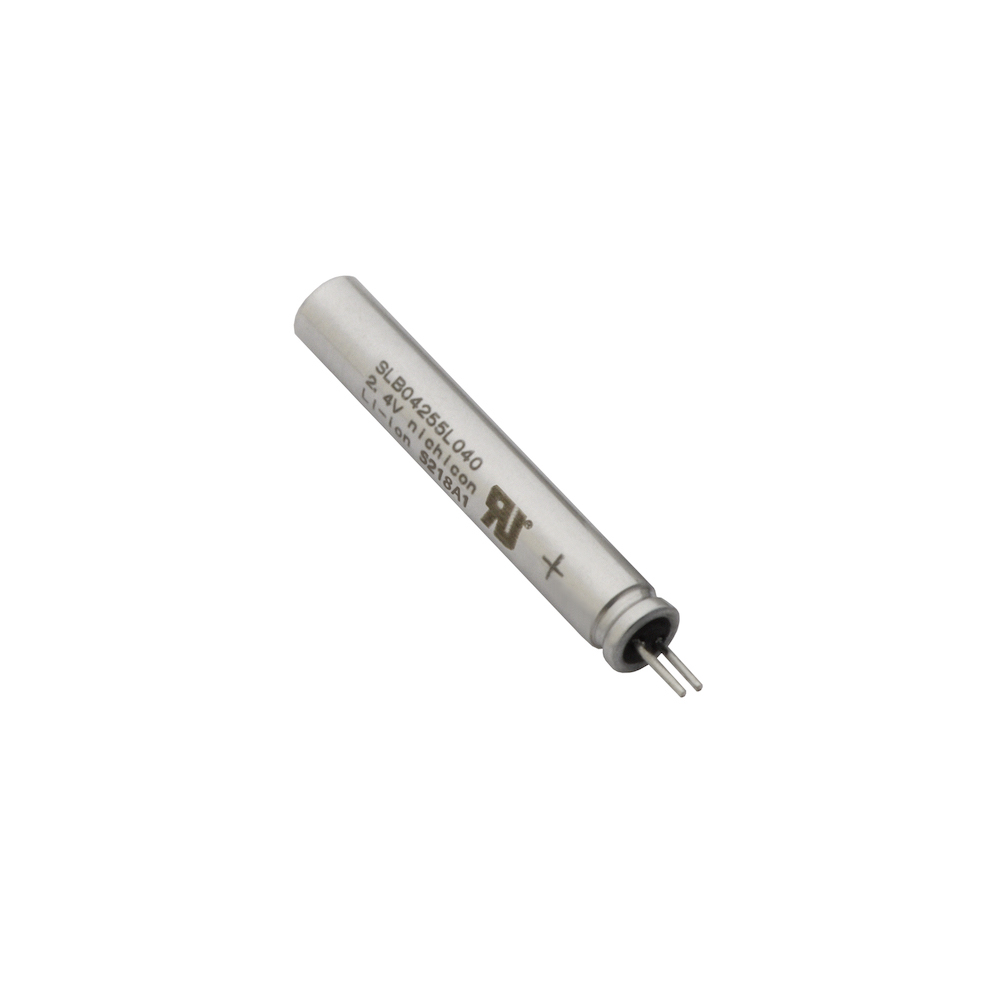
Nichicon’s SLB series are small lithium titanate (LTO) rechargeable batteries designed for applications that need very fast charge and discharge, high cycle life, and reliable operation in the cold, where Li-ion and LiPo designs often need bigger safety margins.
What makes LTO different (and why SLB exists)
LTO cells sit in a useful middle ground between a conventional rechargeable battery and an EDLC supercapacitor:
- Faster charge and discharge than typical Li-ion, with high power density behaviour that can feel “supercap-like” in real designs.
- Long cycle life, with Nichicon showing over 80% capacity retention after 25,000 cycles (test conditions vary, see below).
- Low-temperature usability, specified for operation down to -30°C.
- Improved safety characteristics vs many conventional lithium-ion chemistries, with lower risk of thermal runaway mechanisms commonly associated with graphite anodes.
Core electrical characteristics (SLB series overview)
From the SLB lineup data:
- Nominal voltage: 2.4 V
- Voltage range: 1.8 V to 2.8 V
- Charge/discharge rate: up to 20C max stated for the series
- Temperature range: -30°C to 60°C
Example part numbers and sizes (common SLB cells)
A commonly referenced set in the SLB family includes:
- SLB03070LR35 (0.35 mAh)
- SLB03090LR80 (0.8 mAh)
- SLB04255L040 (4 mAh)
- SLB08115L140 (14 mAh)
- SLB12400L151 (150 mAh)
Nichicon also publishes size and capacity examples including Φ12.5 × 40 mm at 150 mAh and smaller cylindrical formats.
Charging profile and practical charger requirements
The basic approach
SLB cells are charged with a CCCV (constant current, constant voltage) profile:
- Charge to a 2.8 V ceiling (for the typical SLB voltage range)
- Use constant current until the cell approaches the charge voltage, then hold constant voltage while current tapers down
- Nichicon’s published charge and discharge charts show 80% charge in about 3 minutes at 20C, with a cut-off current noted as Capacity × 5% in that example plot.
Charger selection tips (what to look for)
When choosing or designing a charger for SLB, prioritise:
- Accurate CV regulation at ~2.8 V (tight tolerance helps longevity)
- Configurable or well-defined charge current (especially at high C-rates)
- Clear termination behaviour (or intentional “no-termination” if you manage it elsewhere)
- Input current limiting if you expect USB-powered designs or energy harvesting sources
- Thermal management at high C-rates, even for small cells, because fast charging concentrates heat in small volume
Protection and brownout strategy (don’t skip this)
Even though LTO chemistries are known for strong safety characteristics, you still need system-level protection and predictable behaviour at low voltage:
- The SLB lineup data shows a 1.8 V low-end voltage range, so a common strategy is to prevent load operation below a defined threshold and re-enable only when the cell has recovered.
- Ultra-low-power battery voltage monitoring devices are commonly used for this role in SLB reference circuits, with example detect thresholds around 1.8 V and release thresholds around 2.45 V in one published reference set.
In practice, this gives you:
- predictable startup,
- less “half-alive” MCU behaviour,
- improved battery longevity by avoiding deep discharge patterns you did not intend.
Designing with SLB in real products
Where SLB shines
SLB batteries are a strong fit when you have one of these constraints:
- Short, high-current bursts (radio transmit, haptics, motors, solenoids, flash LEDs)
- Very limited charge time (dock-and-go products, intermittent contact charging, fast top-ups)
- Energy harvesting with buffering (PV, vibration, thermal), where you want a rechargeable store that can accept charge quickly
- Cold environment operation where typical Li-ion performance and charging rules become restrictive
Power conversion notes
Because SLB sits around 2.4 V nominal, many systems will need one of the following:
- Boost conversion to 3.3 V, or
- buck-boost if your rails need stability across the full 1.8–2.8 V span, or
- a native low-voltage rail design if your MCU and sensors can run efficiently down in that range.
Also note Nichicon’s guidance that, when comparing to EDLC behaviour, 1 mAh ≈ 10 F as a rough equivalence for thinking about “capacitor-like” buffering in early sizing.
Register your interest
In the Nichicon LTO Battery