
Manufacturers
Solutions
Published
9 June 2026
Written by Adam Yap Electronics Engineer / Digital & Technical Content Specialist
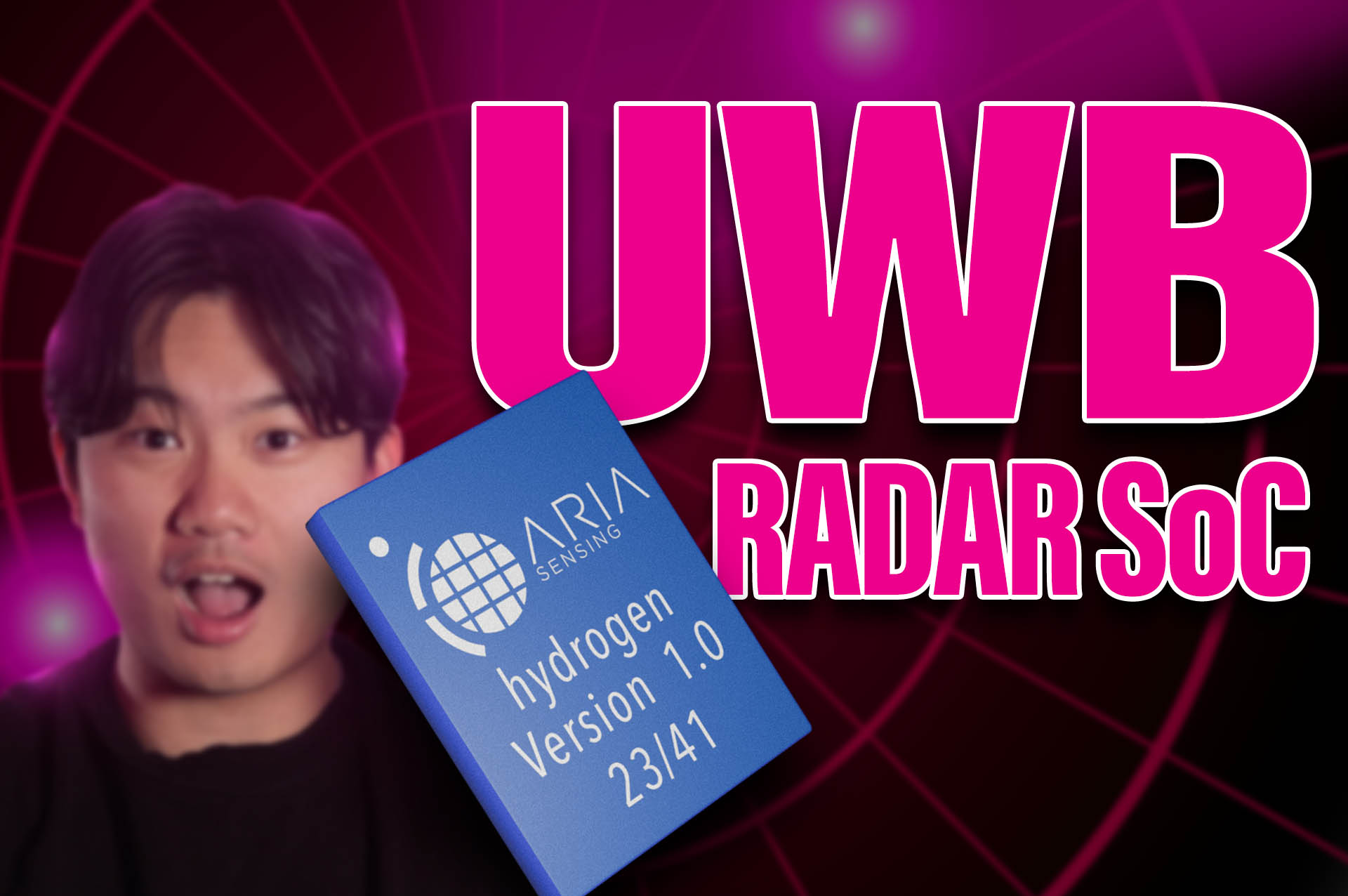
Ultra Wideband usually gets discussed in the context of ranging, tags, anchors, or device finding. Aria Sensing is taking it in a different direction. Its emPulse platform is built around the idea that UWB can do far more when it is treated as a radar technology first, not just as a communications standard with limited sensing attached. The company’s first public chip, Aria Sensing Hydrogen v1p1, is positioned as a UWB radar SoC for scalable 1D, 2D, and 3D sensing.
Why this is different from standard UWB
That distinction matters. A lot of engineers know UWB through communications and localisation products, where compliance with standardised signalling constrains how the radio behaves. Aria’s argument is that radar sensing has different priorities. It is not trying to communicate with another active transceiver. It is trying to detect weak reflections from people and objects in the environment. That shifts the design goal toward sensing resolution, waveform flexibility, and radar optimisation. Aria’s public material on Hydrogen v1p1 reflects that, highlighting programmable pulse bandwidths from 500 MHz to more than 1.8 GHz and support for up to four transmit and four receive antennas.
What Hydrogen v1p1 actually brings
On paper, the chip is a strong technical statement. Aria lists a 7.3 GHz to 9.8 GHz operating range, support for 1D, 2D, and 3D MIMO beamforming, two integrated RISC-V microprocessors, UART and Serial Peripheral Interface (SPI), and a compact 9 mm x 9 mm QFN64 package. It also lists a 1.8 V supply and 90 mA power consumption, which helps support the company’s positioning around ultra-low-power sensing.
The important point is not just that the chip is small. It is that Aria is trying to collapse much more of the radar problem into a single SoC. That can reduce external processing, simplify system architecture, and make UWB radar more realistic for embedded product teams that do not want to build a bulky sensing stack around the chip.
Where UWB radar makes sense
Aria’s applications page gives a good view of where the company thinks this matters most. It lists people tracking, fall detection, contactless vital signs, in-cabin monitoring, gesture recognition, smart home occupancy sensing, smart television interaction, and hidden anti-intrusion sensing. These are all cases where the sensing system benefits from a few shared traits: privacy, robustness, and the ability to work through non-metal obstacles such as clothes, jackets, blankets, or some walls.
That is also where UWB has an interesting edge. Aria explicitly claims better penetration capability than competing high-resolution radar approaches and highlights that no optical images are acquired. For design engineers, that combination is valuable. You can build around radar-based awareness without the baggage of cameras, lighting sensitivity, or image privacy concerns.
Why engineers should pay attention
The bigger story here is that Aria Sensing is trying to create a new product category, not just another UWB module. emPulse is being framed as a radar-first UWB architecture, and Hydrogen v1p1 is the first concrete proof point. Whether the target is smart home occupancy, automotive in-cabin sensing, gesture interfaces, or contactless patient monitoring, the pitch is the same: higher radar resolution, low power, privacy-friendly sensing, and more system flexibility from a compact SoC.
For engineers working on embedded sensing products, that makes Aria Sensing Hydrogen v1p1 worth watching. It is not trying to replace every radar architecture. It is trying to make UWB radar much more capable than most people currently assume.
Comments are closed.
Comments
No comments yet