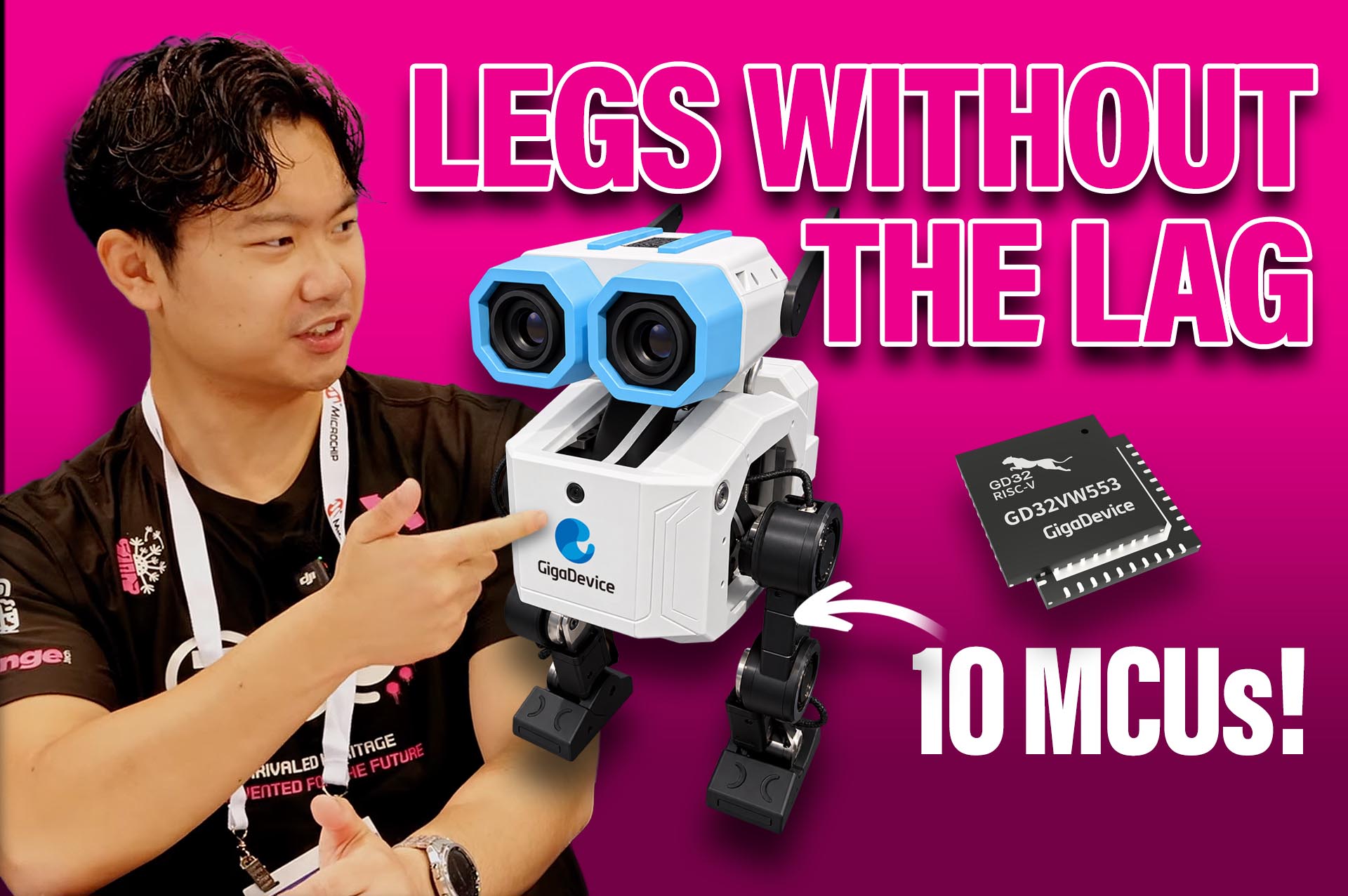

What does it take to make a robot walk? Balance, coordination and a lot of precisely timed movements. While it might look simple enough, getting a robot to take even a few steps involves some serious engineering.
At Embedded World North America 2026, Adam Yap from ipXchange caught up with Lon Howze from GigaDevice to explore how the company’s growing microcontroller portfolio is helping engineers tackle the challenges of robotics, real-time control and wireless connectivity.
Why Use Ten Microcontrollers in One Robot?
At the GigaDevice booth, a small bipedal robot demonstrated just how important coordination is when designing robotic systems.
Rather than relying on a single microcontroller to manage every movement, the robot uses five MCUs in each leg, with each controller responsible for an individual joint.
But why distribute the work across ten microcontrollers when a single powerful MCU could potentially handle the calculations?
By giving each joint its own dedicated controller, engineers can distribute motor-control tasks throughout the system. This approach allows individual joints to operate independently at a local level, making complex designs more modular and easier to expand.
Of course, distributing control introduces another challenge. All those joints still need to move together, and even a small delay in communication could mean the difference between a robot walking and falling flat on its face.
Keeping Everything in Sync
This is where GigaDevice’s high-performance microcontrollers come into play.
With EtherCAT support available in its higher-end MCU portfolio, GigaDevice is helping engineers address the demanding communication and timing requirements of robotics and industrial automation.
EtherCAT enables precise, low-latency communication between controllers, helping multiple motors operate in sync. For engineers developing increasingly complex robotic systems, this means they can distribute control without sacrificing the coordination their applications require.
And as Lon explains, these requirements are not limited to demonstration robots. GigaDevice’s microcontrollers are also used for joint control in more advanced robotic applications, including humanoid robots.
Beyond Motor Control: Connecting the System
Of course, making a robot move is only part of the challenge. Engineers also need ways to communicate with it, monitor its performance and control it remotely.
Alongside its high-performance MCUs, GigaDevice offers RISC-V-based wireless microcontrollers that integrate Wi-Fi and Bluetooth connectivity with processing capabilities for additional application tasks.
Rather than burdening the motor controllers with wireless communication, these solutions can handle external connectivity separately, helping engineers keep time-critical functions focused on their primary tasks.
The applications extend well beyond robotics. From simple internet-connected clocks to industrial monitoring and automation systems, GigaDevice’s portfolio offers engineers options across a wide range of performance, connectivity and cost requirements.
Discover More from GigaDevice
As robotics and Physical AI continue to develop, choosing the right microcontroller is about more than processing power. How efficiently different parts of a system communicate, respond and work together can be just as important.
Watch our full interview with Lon Howze at Embedded World North America 2026 to see the robot in action and discover how GigaDevice’s microcontroller portfolio is helping engineers build more capable and connected systems.
Find out more about GigaDevice at https://www.gigadevice.com/.
Comments are closed.
Comments
No comments yet