
Products
Published
24 November 2026
Written by Jasleen Purba
Switching processor architectures introduces engineering cost.
A new platform needs to be evaluated, software brought up, peripherals tested and the development environment understood before it can become a serious candidate for a product.
That creates inertia. Teams often continue using familiar microcontrollers and processors because the existing stack is known and supported.
For applications involving local artificial intelligence, robotics and increasingly complex sensor processing, that architecture may eventually become the constraint.
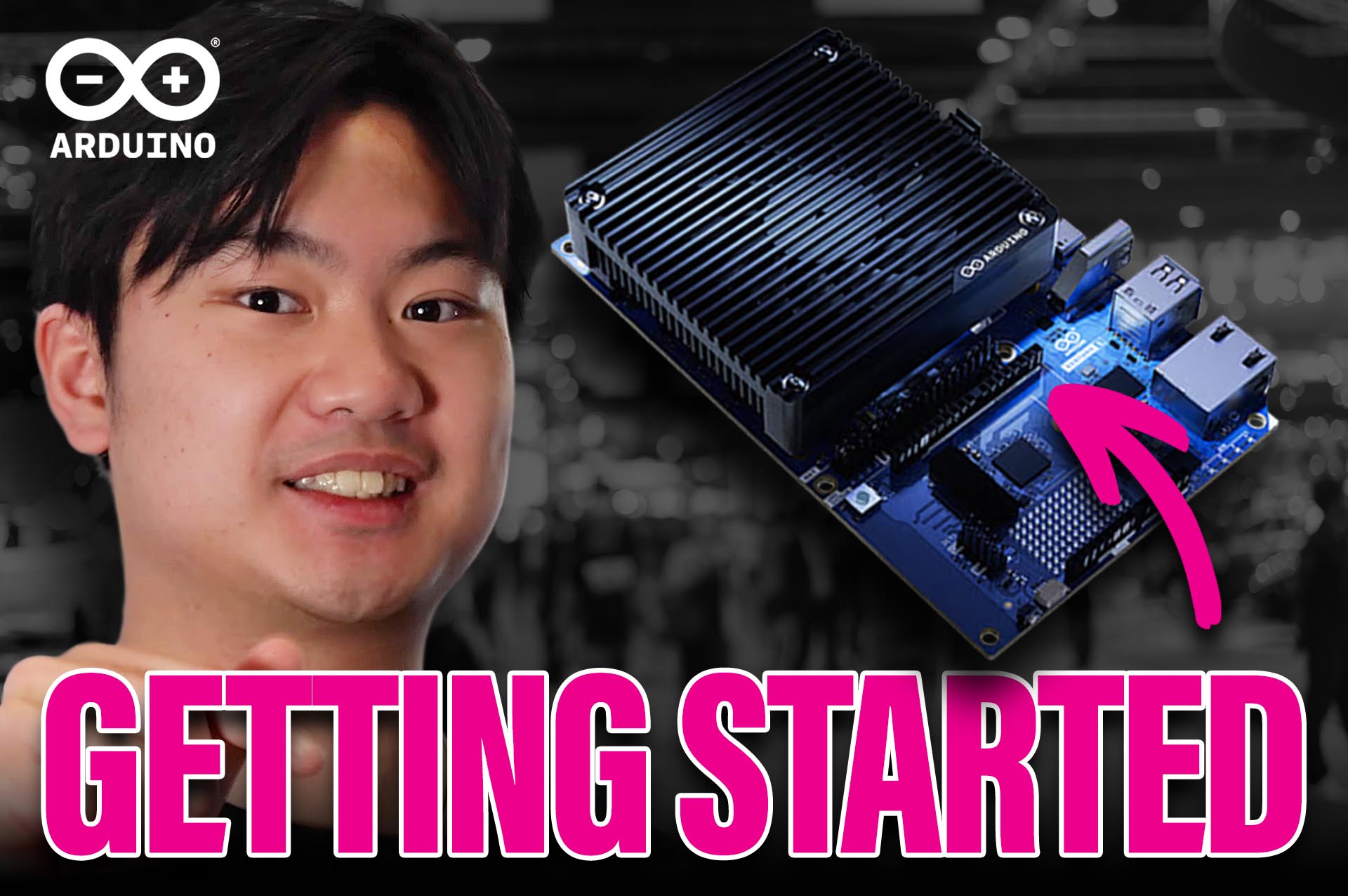
The Arduino VENTUNO Q is designed around that problem.
Separating AI compute from real-time control
VENTUNO Q uses a dual-processor architecture.
The main application processor is based on Qualcomm Dragonwing IQ8 silicon. Its Hexagon NPU provides up to 40 dense TOPS of AI acceleration, backed by 16 GB of LPDDR5 memory.
This gives the board enough headroom for workloads including computer vision, speech processing and local language models.
A separate STM32H5F5 handles deterministic control.
The microcontroller uses an Arm Cortex-M33 core running at 250 MHz, providing a dedicated environment for sensors, actuators and timing-sensitive functions.
This division is useful in physical AI systems. Vision, inference and higher-level decision making can run under Linux while time-critical control remains on the microcontroller.
Evaluating the hardware
The next question is whether the board can connect to the rest of the system.
VENTUNO Q provides three MIPI CSI-2 camera interfaces, HDMI, USB 3.0, 2.5 Gbit Ethernet, Wi-Fi 6 and Bluetooth 5.3.
CAN-FD is exposed through dedicated screw terminals and uses an onboard physical-layer transceiver, making it directly relevant to motors, controllers and industrial networks.
Expansion is also broad. Traditional UNO headers allow existing Arduino hardware to be reused, while a 40-pin header provides access to Raspberry Pi-style HATs. M.2 adds NVMe storage expansion.
The 160 × 100 mm format is considerably larger than an UNO Q, reflecting the additional compute, I/O and cooling requirements.
Reducing software evaluation time
Hardware specifications only matter if engineers can get useful workloads running quickly.
Arduino App Lab is the fastest route into the platform.
It combines Linux application development, Arduino sketches and AI models in one environment. Bricks provide reusable functionality for common tasks including web interfaces, cameras and AI inference.
Arduino also integrates Edge Impulse models into App Lab, allowing custom vision, audio and sensor models to be deployed through supported AI Bricks.
For initial evaluation, this gives engineers a relatively short route from board bring-up to a working proof of concept.
The platform remains a standard Ubuntu computer underneath. Teams can move to Python environments, Docker containers, SSH, custom services or their preferred IDE when the project requires greater control.
Testing local AI
The video demonstrates this workflow with local face and gesture recognition.
The examples use models available through the Arduino ecosystem and execute inference locally on the board rather than requiring a cloud inference service.
These examples are deliberately simple, but they exercise the same underlying components required by more substantial machine vision systems: camera input, model execution, application logic and local processing.
The same platform can then be extended towards multi-camera inspection, robotics, speech interfaces and other physical AI workloads.
Support and product longevity
For a production-oriented evaluation, processor availability also matters.
Qualcomm currently lists the Dragonwing IQ-8275 in its Product Longevity Program until 2038.
Arduino maintains board documentation, pinouts, schematics, tutorials and application examples, while Qualcomm provides its own Dragonwing development resources and AI tooling.
VENTUNO Q therefore has a clearer long-term development path than a board intended only for short-lived experimentation.
From evaluation to production
VENTUNO Q is most relevant where the project needs substantial local AI processing and real-time physical control in the same system.
The practical evaluation sequence is straightforward:
Start with the application workload. Test available AI models. Connect the required cameras and interfaces. Verify the real-time control path. Measure power and thermal behaviour. Then decide whether the platform provides sufficient headroom for the final system.
That is the useful role of VENTUNO Q.
It provides an accessible evaluation platform for Qualcomm Dragonwing silicon, while retaining familiar Arduino development concepts for the real-time side of the design.
If you’d like to win an UNO Q, a smaller, more prototype-friendly board, to build out your initial ideas, register here: https://form.jotform.com/262436259891367
Comments are closed.
Comments
No comments yet