
Embedded software development is often slow, manual and difficult to scale. Engineers need to read large volumes of documentation, understand microcontroller capabilities, write specifications, generate code, test it on real hardware, identify bugs, debug issues and repeat the process until the system works reliably.
At Microelectronics US, ipXchange spoke with Ethan, CEO of Embedder, about how the company is trying to automate more of that workflow with an AI firmware engineer.
Embedder is designed to support the embedded software development lifecycle from initial board bring-up through to debugging, iteration, deployment and maintenance. The platform can work from vendor documentation, datasheets, schematics and other technical material to understand the target hardware and generate software based on the engineer’s requirements.
According to Ethan, one of the biggest problems in traditional embedded development is the amount of manual research required before engineers can even begin writing code. On complex microcontrollers, teams may need to work through thousands of pages of documentation to understand how to use the device correctly. That process is time-consuming, error-prone and can create long development cycles.
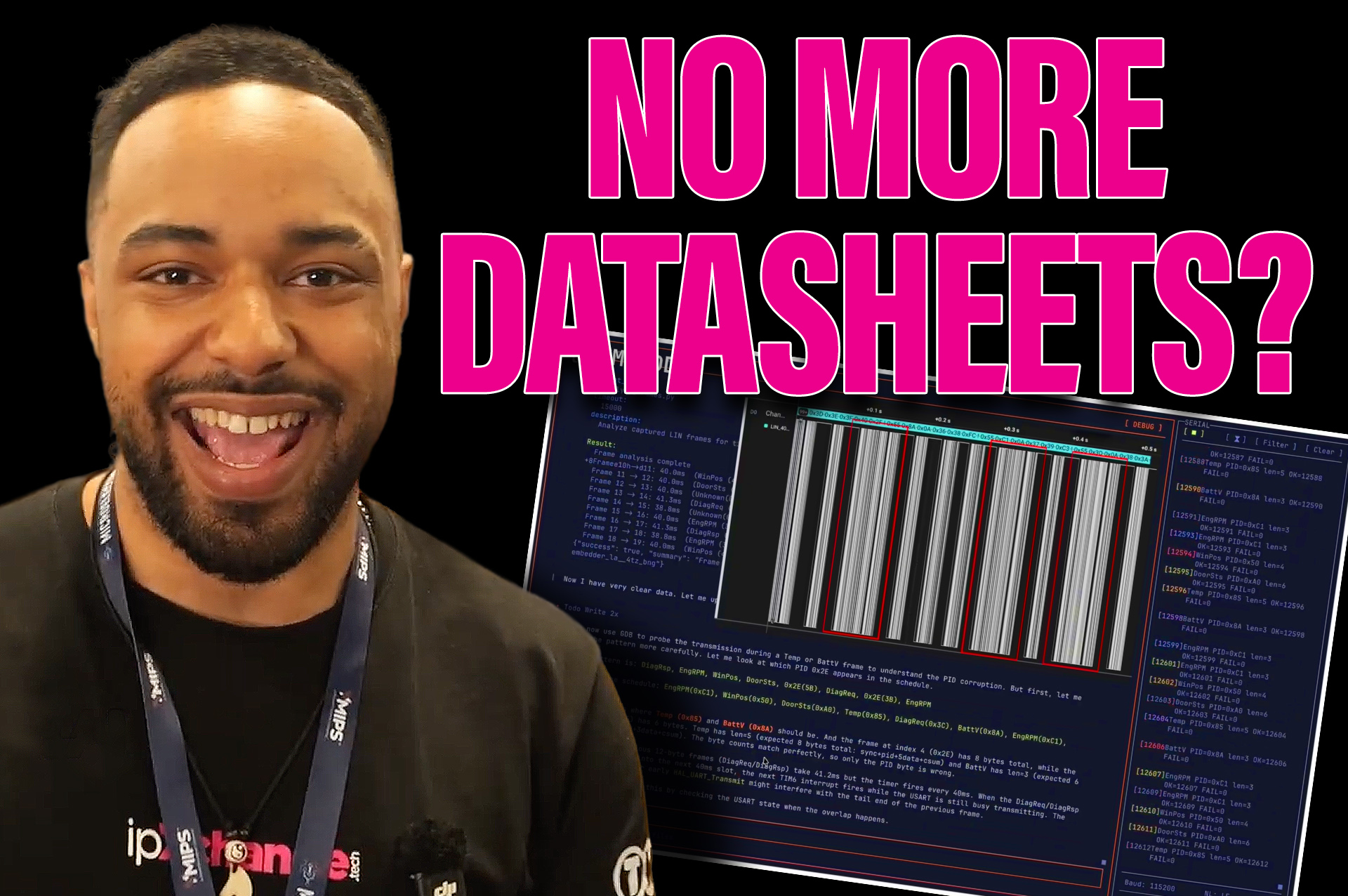
Embedder aims to reduce that burden by automating documentation research, specification generation, code creation and hardware validation. In the demo shown at Microelectronics US, the tool was connected to real hardware and test equipment. The example focused on a timing issue that had been created for the demonstration.
The AI agent was able to interface with a logic analyser, detect that frames were dropping, review the relevant documentation and code, diagnose the likely root cause, apply a code change, rebuild the project, flash the board and run another capture to confirm that the timing issue had been fixed.
This hardware-in-the-loop capability is important because embedded software cannot be fully validated in isolation. Real boards, real signals and real timing behaviour matter. By connecting AI-driven development to physical test equipment, Embedder is positioning its platform as more than a code generation assistant. It is aiming to act as a practical engineering tool for debugging and iteration on real embedded systems.
The company says its AI has native hardware understanding for more than 500 microcontrollers and support for around 2,000 peripherals, while also allowing users to upload their own documentation, datasheets and schematics for custom hardware.
For engineering teams, the value proposition is clear: less time spent searching through documentation, faster root cause analysis and more automated iteration between code, hardware and test results.
AI firmware engineering still needs engineering judgement. Ethan was clear that system design knowledge remains important for using the tool effectively. But if AI agents can reliably accelerate bring-up, debugging and maintenance, they could become a serious force multiplier for embedded development teams.
The real question is whether tools like Embedder can consistently deliver outside the demo environment. For sceptical engineers, the company is offering free access online so users can test the platform against their own embedded software challenges.
Comments are closed.
Comments
No comments yet