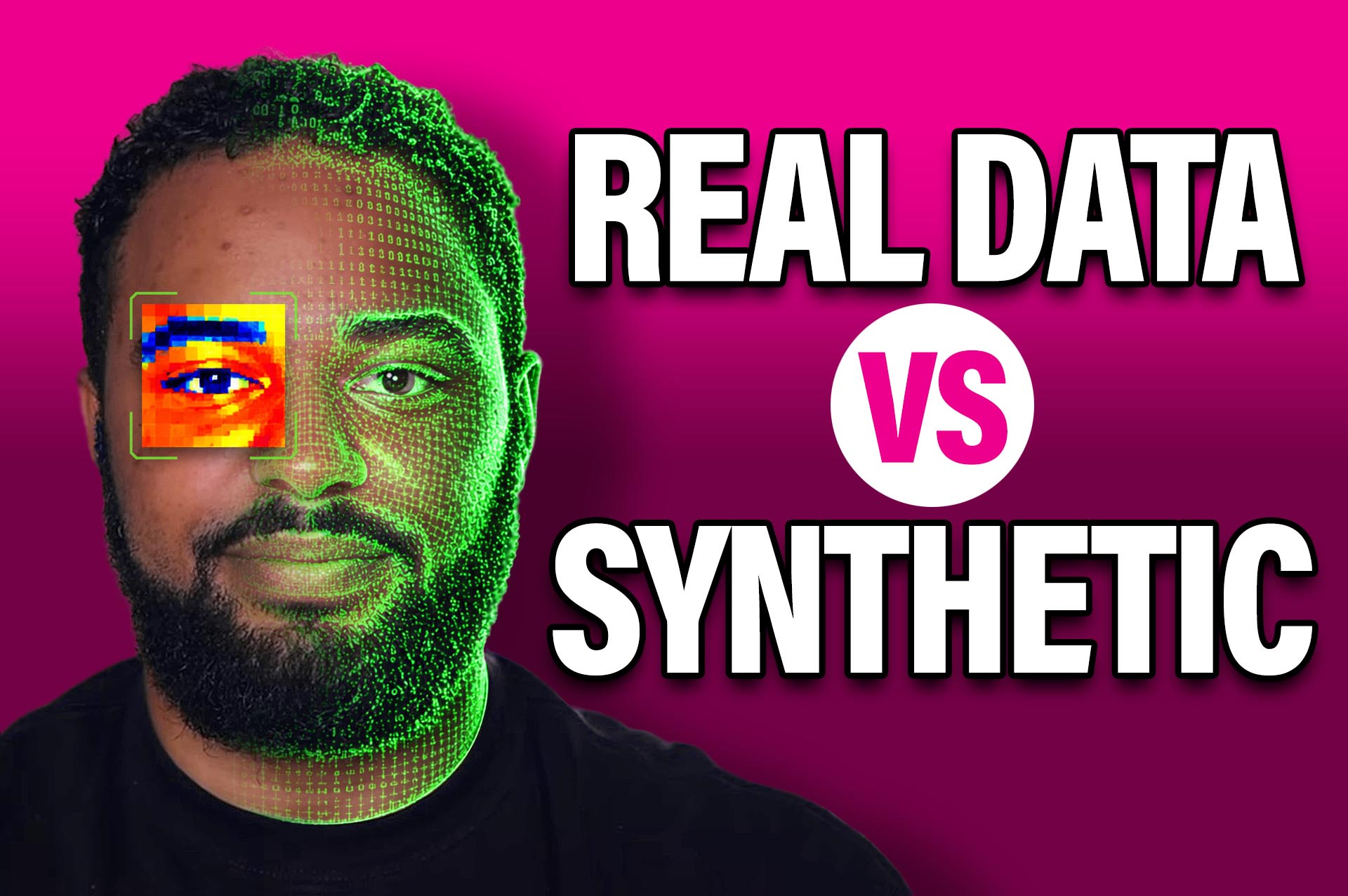

Computer vision models need data, and collecting enough representative real-world imagery can quickly become one of the most expensive parts of development.
Rare faults may be difficult to reproduce. Manual annotations introduce mistakes. Some conditions may be unsafe or impractical to capture at all.
Synetic is taking a different approach: generate the training data instead.
In our interview with CEO and co-founder David Scott, we look at how synthetic data can be used for computer vision training, the evidence behind the approach, and the limitations engineers still need to account for.
What synthetic data adds
Synetic generates its datasets through physically based rendering rather than generative artificial intelligence.
Because the entire scene is known during rendering, each image can carry exact metadata alongside the pixels.
That can include:
- Object classes
- Bounding boxes
- Segmentation masks
- Depth
- Position
- Occlusion
- Camera parameters
This removes much of the manual annotation process required with captured imagery.
It also gives engineers control over lighting, viewing angle, distance, weather and other variables that may be difficult to reproduce consistently in the real world.
Can synthetic data actually perform better?
That is the important question.
Synetic published a benchmark focused on apple detection in orchards. Synthetic and real-world training datasets were compared across seven object detection architectures while evaluation was performed against real-world validation imagery.
The strongest reported result showed a 34.24% increase in mAP50-95 from synthetic-only training compared with the real-data baseline.
The work was also independently reproduced and reviewed by researchers at the University of South Carolina.
Synetic has published the dataset and supporting scripts so engineers can reproduce the tests rather than relying solely on the company’s claims.
Why cleaner annotations matter
Real datasets are rarely perfect.
Human annotators can miss objects, draw inconsistent boundaries or classify samples incorrectly. Those errors become part of the model’s training signal.
A rendered scene already knows exactly where every object is.
This allows synthetic datasets to provide consistent annotations at pixel level and makes it easier to generate difficult scenarios deliberately.
That does not automatically make a synthetic dataset better. The rendered environment still needs to represent the conditions the deployed system will encounter.
The main limitation: predicting the real world
This is also the central weakness discussed in the interview.
With real imagery, the scene has already happened. The dataset records whatever conditions existed when the image was captured.
With synthetic data, engineers need to decide which conditions to generate.
If an unexpected real-world edge case was never represented in the synthetic environment, the model may still fail.
Synetic’s approach is therefore iterative. When a new failure condition appears, that scenario can be recreated synthetically and added to the training pipeline.
The advantage is that engineers do not necessarily need to reproduce the physical scenario and recapture a full dataset.
Real-world validation still matters
Synthetic training does not remove the need for real data entirely.
Synetic uses real-world imagery for validation to confirm that the resulting model generalises outside the rendered environment.
That distinction is important.
The aim is not to prove that a model performs well on synthetic images. It needs to perform well on the camera feed it will eventually encounter in deployment.
The apple benchmark followed this approach by training on synthetic data while evaluating against real-world imagery.
Moving from data into the SDK
Synetic is also applying the same work through its LYNX computer vision SDK.
LYNX currently supports bring-your-own Open Neural Network Exchange (ONNX) models and provides a common runtime around capabilities including detection, segmentation, tracking, pose and depth processing.
The SDK is designed to run inference locally and supports deployment across Linux, Windows, macOS, Android, iOS and NVIDIA Jetson environments.
Synetic is also developing its own model catalogue trained using its synthetic data pipeline. At the time of writing, those catalogue models are not yet generally available, so the current public workflow centres on importing existing ONNX models.
Where synthetic data makes sense
The strongest applications are those where representative real-world data is expensive, rare or difficult to label.
The interview discusses agriculture and robotics in particular.
One previous Synetic project used computer vision to monitor cattle over time. Tracking and depth information were used to identify individual animals, estimate weight and monitor behaviour for deviations that could indicate health issues.
Other potential applications include industrial inspection, autonomous systems, safety monitoring and environments where unusual edge cases need to be represented during training.
A different approach to the data bottleneck
Synthetic data does not remove every problem in computer vision.
Engineers still need realistic scene design, representative edge cases and real-world validation.
What it changes is how quickly those datasets can be created and modified.
Instead of waiting to capture every possible scenario physically, developers can generate controlled examples, create precise annotations automatically and iterate when new failure modes appear.
For computer vision teams where the dataset has become the development bottleneck, that makes synthetic data an increasingly practical engineering option.
Comments are closed.
Comments
No comments yet