
Products
Published
4 November 2026
Written by Jasleen Purba
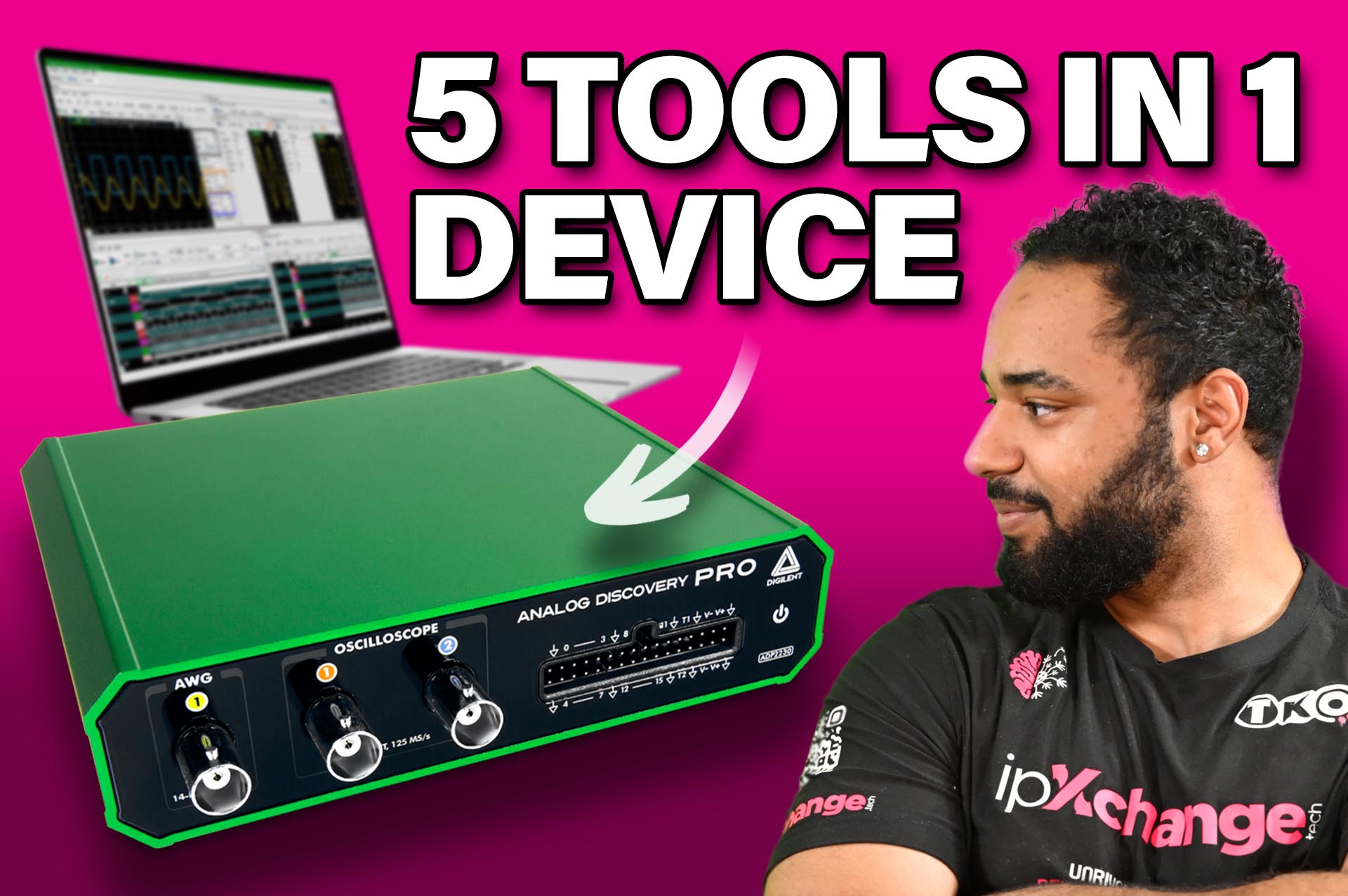
Building an electronics laboratory can be expensive, and finding the space for all the necessary equipment can be just as challenging. Digilent’s Analog Discovery Pro 2230 (ADP2230) offers an alternative, combining multiple test and measurement instruments into a single compact device.
For electronics engineers, having the right tools is essential. Oscilloscopes, waveform generators, power supplies and logic analysers all play important roles in circuit development, debugging and validation. However, purchasing these instruments individually can quickly become expensive, particularly for students, independent developers and engineers working with limited laboratory space.
The Digilent Analog Discovery Pro 2230 (ADP2230) aims to address both challenges by integrating several essential laboratory functions into one portable instrument, operated through Digilent’s WaveForms software.
Multiple Instruments, One Compact Device
Rather than requiring a dedicated piece of equipment for each measurement or testing function, the ADP2230 combines analog and digital capabilities within a single unit.
Its hardware includes two 50 MHz analog input channels, a 15 MHz analog output and 16 programmable CMOS digital input/output channels, accessible through a 32-pin connector.
These capabilities allow engineers to perform a variety of testing tasks, from examining analog signals and generating waveforms to working with digital circuits.
Unlike a conventional benchtop oscilloscope, the ADP2230 does not feature an integrated display. Instead, it connects to a computer via USB-C, with Digilent’s WaveForms software providing the interface for controlling instruments, configuring measurements and analysing results.
This approach significantly reduces the physical space required for a testing setup. With a laptop, the ADP2230 and the circuit under test, engineers can carry out a range of measurements without needing an extensive laboratory bench.
Generating and Measuring Signals with WaveForms
Hardware is only part of the equation. Much of the ADP2230’s flexibility comes from its integration with Digilent WaveForms, which provides access to its various measurement and signal-generation functions.
In our hands-on demonstration, we begin by using the ADP2230 as an oscilloscope to observe the output of an external power supply.
By adjusting the supply voltage, we can monitor the corresponding changes in the measured signal, including the gradual voltage decay when the supply is switched off. The oscilloscope also allows us to observe noise present on the power supply output.
Next, we explore the device’s waveform-generation capabilities.
Using the WaveForms interface, we configure the ADP2230 to generate a 10 MHz sine wave and examine the resulting signal through its oscilloscope function. This demonstrates how the instrument can both generate and measure waveforms within the same testing environment.
Manipulating Measurement Data Without Leaving WaveForms
Beyond conventional signal generation and measurement, WaveForms also provides tools for manipulating and analysing acquired data.
Engineers will often export oscilloscope measurements into external applications such as MATLAB or Python for additional processing. However, WaveForms includes built-in mathematical functions that can handle a variety of calculations directly.
During the demonstration, we generate a 1 kHz triangle wave and use WaveForms to create a calculated channel based on the measured signal.
By applying a simple multiplication operation, we double the amplitude of the displayed waveform. We then modify the calculation to halve its amplitude instead.
Although relatively simple, this example illustrates how engineers can perform mathematical operations on measurements without switching between multiple applications.
WaveForms also supports additional calculations, measurement functions and triggering capabilities, providing flexibility for more advanced testing requirements.
A Practical Alternative to Traditional Bench Equipment?
The cost of equipping an electronics laboratory can quickly add up.
Individual benchtop oscilloscopes, waveform generators and programmable power supplies can each represent a significant investment, even before accounting for additional instruments such as logic analysers.
By consolidating several of these functions into one device, the ADP2230 offers an alternative for engineers who need a versatile testing setup but have limited space or equipment budgets.
While dedicated instruments may still be preferable for applications requiring particular performance characteristics or specialised capabilities, the ADP2230 provides a convenient way to access several commonly used laboratory tools through a single platform.
For students, electronics developers and engineers working in compact environments, this combination of portability, multifunctionality and software-based control makes it an option worth considering.
Bringing Test and Measurement Together
The Digilent Analog Discovery Pro 2230 demonstrates how integrating hardware and software can simplify the electronics testing workflow.
With analog measurement, waveform generation, digital I/O and built-in data manipulation available through WaveForms, engineers can perform a range of development and debugging tasks without relying on a collection of separate benchtop instruments.
In our latest hands-on demonstration, we explore the ADP2230’s hardware, generate and measure signals, and show how WaveForms can be used to manipulate measurement data directly.
Watch the full ipXchange demonstration to see the Digilent Analog Discovery Pro 2230 in action.
Comments are closed.
Comments
No comments yet