
Products
Manufacturers
Solutions
Published
11 August 2026
Written by Dawn Maindidze
Choosing the right AI processor for a product should come down to performance, power and application requirements not how painful it will be to learn another development environment.
During our recent visit to California, ipXchange stopped by Ambarella’s San Francisco offices to speak with Pietro Cicalese, Senior Technical Marketing Engineer, about how the company is approaching low-power edge AI and, increasingly, the developer experience surrounding its hardware.
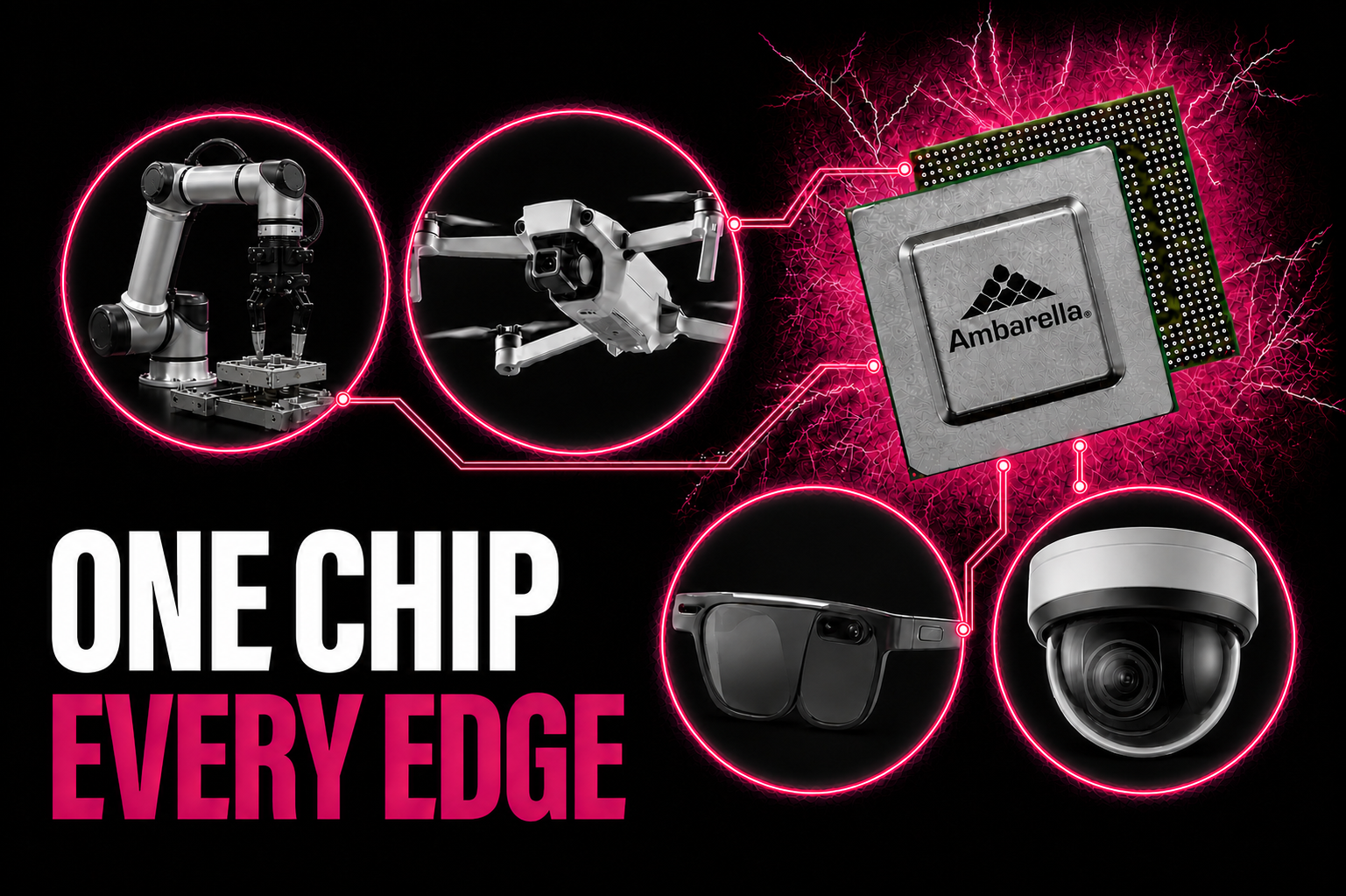
Ambarella has built a broad portfolio of AI SoCs for applications including intelligent cameras, industrial systems, drones and fleet telematics. That gives engineers plenty of choice when balancing AI performance, power consumption and application-specific requirements.
But a large hardware portfolio creates another problem: how do you move between processors without having to learn a completely different SDK and workflow every time?
Choose the SoC, keep the workflow
This is where Ambarella’s Cooper developer platform becomes particularly interesting.
Rather than treating every processor as an entirely separate development environment, Ambarella is working towards a more consistent software experience across its SoC portfolio.
As Cicalese explained, engineers should be able to move between chips without having to worry about the differences between individual SDKs. New development tools are intended to understand which device is being targeted and handle more of that translation automatically.
That means an engineering team can focus more heavily on choosing the hardware that best fits its actual application.
A low-power vision product may require a very different processor from a more demanding robotics or multimodal AI system. Instead of software complexity discouraging engineers from changing devices, the goal is to let them select the appropriate Ambarella SoC while continuing to work within a familiar development environment.
Making evaluation easier
Ambarella is also trying to reduce the work required before an engineer even commits to the platform.
Cicalese acknowledged that migrating from an existing processor can be intimidating. Engineers have to learn a new SDK, understand new hardware and navigate unfamiliar documentation before they can properly determine whether the technology is suitable for their product.
Cooper and Ambarella’s Developer Zone aim to bring more of those resources into one place.
Rather than simply providing isolated examples, the company is building towards complete applications that engineers can run, inspect and modify.
Cicalese used warehouse surveillance as an example. A traditional implementation could require an engineer to deal separately with the camera pipeline, ISP, inference software and wider application. Ambarella’s approach is to provide a complete working example with source code that can then be adapted to the engineer’s requirements.
Ambarella is also planning remote access to its hardware, allowing developers to connect to supported chips through their IDE and begin experimenting before purchasing a development kit.
Using AI to develop AI
Perhaps the most interesting part of Ambarella’s roadmap is the role AI itself could play in simplifying development.
Cicalese described plans for agentic tools that could interact directly with the development environment. Instead of asking an AI assistant how to perform a task, copying its instructions and then carrying them out manually, the idea is for the tool to perform more of that work itself eventually.
This could also help engineers work outside their main area of expertise. Someone experienced with camera and ISP development, for example, may be less familiar with AI inference or LLMs. Cooper is intended to make those parts of the stack easier to access without requiring every engineer to become an expert in every discipline.
Ultimately, Ambarella’s proposition is becoming about more than low-power AI silicon.
The bigger idea is straightforward: give engineers a broad choice of SoCs, then make the software experience consistent enough that choosing different hardware does not mean starting again.
As edge AI becomes more capable and applications demand increasingly specialised combinations of compute, vision and power efficiency, that flexibility could become just as important as the silicon itself.
Watch our full interview with Pietro Cicalese to learn more about Ambarella, Cooper and how the company is simplifying development across its edge AI SoC portfolio.
Comments are closed.
Comments
No comments yet