
Was that dress black and blue, or white and gold?
The viral image was a great reminder that seeing something and understanding it are not always the same thing. Even when we feel completely certain about what we are looking at, ambiguity can lead us to the wrong conclusion.
AI systems can face a similar challenge.
When presented with similar, overlapping or difficult-to-distinguish data, an AI model still needs to determine which information matters most before making a decision.
Getting AI to Squint
When humans struggle to see something clearly, we instinctively take a closer look. We might move nearer, change our perspective or simply squint.
Andrew from Squint Cognition joined us in the ipXchange Studio to explain how they are applying a similar idea to artificial intelligence, helping AI focus more closely on difficult data when making decisions.
Rather than treating every input in exactly the same way, the aim is to help AI identify situations where additional attention is needed and better distinguish between similar possibilities.
Putting It to the Test
Of course, the best way to understand a technology is to see it in action.
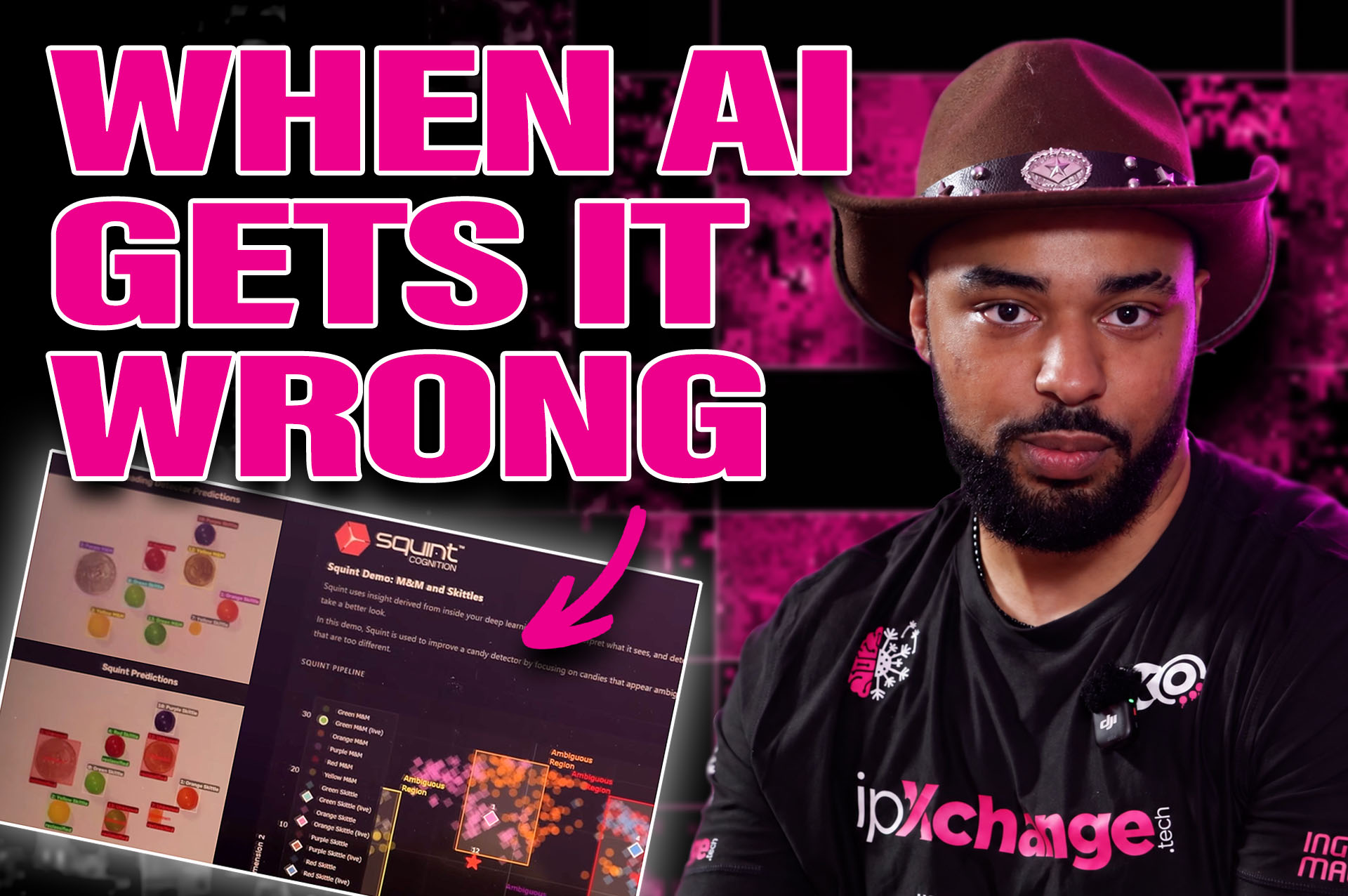
For the demonstration, Andrew put Squint Cognition to work on a particularly challenging dataset: M&Ms and Skittles.
While distinguishing between sweets might sound simple, objects with similar colours, shapes and appearances provide an easy way to demonstrate a much broader problem faced by AI systems.
When the difference between two possibilities becomes small, being able to recognise that uncertainty and take a closer look can become increasingly important.
Watch our conversation with Andrew to learn more about Squint Cognition and see the technology in action.
To find out more about Squint Cognition, visit: https://www.squintcognition.com
Comments are closed.
Comments
No comments yet