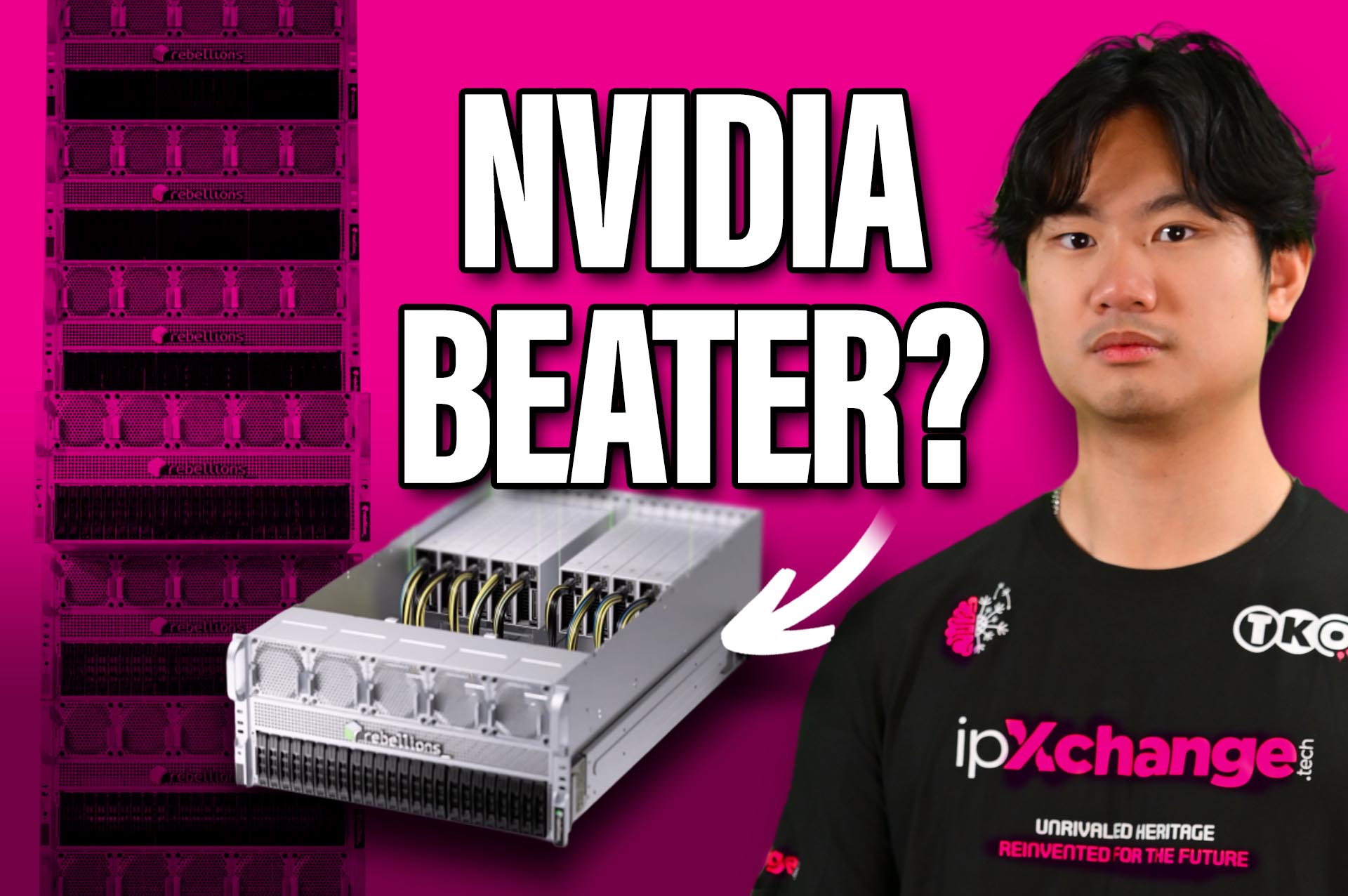

Training large AI models has made the GPU the centre of the AI hardware market.
But serving those models to users at scale is a different job, often with strict power and cost limits.
We visited Rebellions in Seoul, South Korea, to see how its Rebel100 platform is built for that job.
Rebelling against incumbent server architectures
Rebellions sees itself as the underdog, rebelling against the architectures that dominate AI servers today.
Many inference start-ups build highly specialised chips. Rebellions has kept its architecture and software general-purpose, so customers can tailor the platform to their own use cases.
A chip designed from the ground up for inference
As models grow, they no longer fit comfortably on a single card, and they need to serve more users at once.
Rebel100 combines four neural cores with four stacks of HBM3E memory. According to Rebellions, a single card can hold a model of around 120 billion parameters, with a maximum TDP of around 600 W.
From a single card to a full pod
Eight Rebel100 cards make a server at around 7 kW. Four servers make a rack at around 28 kW, keeping it under the standard 32 kW limit, and up to seven racks form a pod.
Rebellions’ engineers work with each customer to choose the right configuration, from a single server for one or two models up to a pod for a large-scale inference platform.
Moving GPU-trained models across with minimal effort
Rebellions’ software stack is open source. Models built in frameworks such as PyTorch can be compiled for Rebel100.
Rebellions builds official plugins for these projects, so GPU-trained models can move across with as little effort as possible.
Why sovereign AI matters
Alongside hyperscaler growth, Rebellions sees rising demand from enterprises and neoclouds for secure, on-premise AI, where organisations keep control of their data from training to inference.
Its supply chain is based entirely in Korea, with HBM from SK hynix and chips made by Samsung, reducing exposure to geopolitical disruption.
Getting hands-on with Rebel100
The SDK and documentation are available on the Rebellions website. Customers in Korea can arrange on-site testing, while global customers can get remote access through a Kubernetes pod, a virtual machine or bare metal.
Watch our full interview with Rebellions to find out how Rebel100 scales from a single chip to a full inference pod.
Comments are closed.
Comments
No comments yet