
Products
Manufacturers
Published
3 September 2026
Written by Jake Morris
Connect with Jake Morris on LinkedIn
Running an AI model is one problem. Running that model reliably, efficiently and economically in production is another.
As models grow, infrastructure requirements can escalate quickly. More accelerators increase cost, workloads become harder to schedule, and engineering teams have to manage routing, utilisation, observability and deployment alongside the application itself.
NeuReality believes this infrastructure layer needs a different approach. Its answer is NR-NEXUS, an inference operating system designed to coordinate production AI workloads across heterogeneous compute environments.
The problem with current inference deployment
Teams broadly have two common options when deploying large AI workloads.
The first is a managed inference API. This provides a simple route to deployment, but engineers have less control over infrastructure, data paths, hardware selection and cost.
The second is to operate inference infrastructure internally. This gives teams much greater control, but introduces a substantial engineering workload. GPUs or other accelerators need to be provisioned, models deployed, traffic routed, resources monitored and performance continuously tuned.
As inference moves from experimentation into production, these operational requirements become increasingly important.
What is NR-NEXUS?
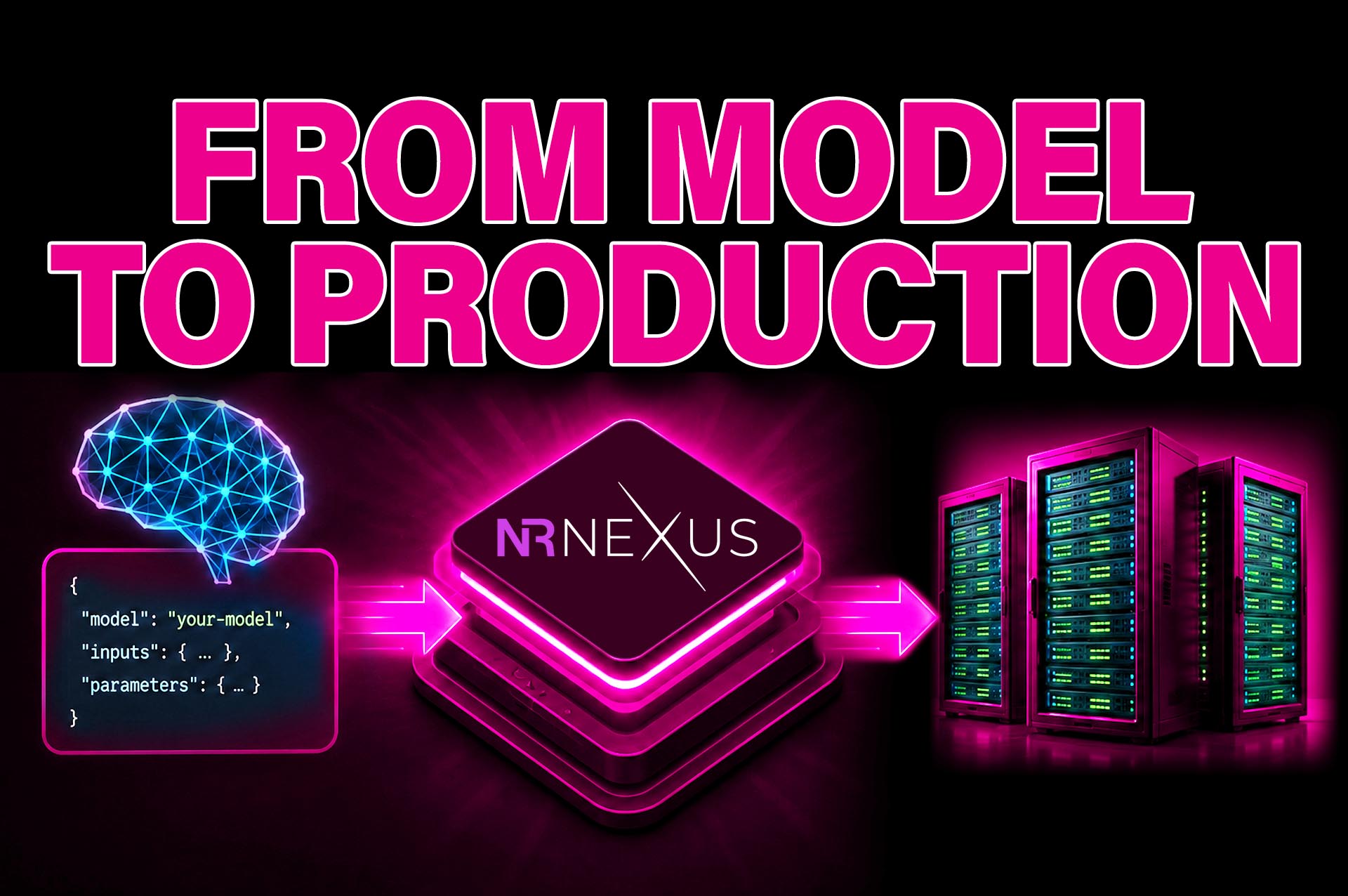
NeuReality describes Nexus as an operating layer between AI applications and the infrastructure executing their workloads.
The platform takes information about models, workloads and performance requirements, then manages how those workloads are executed across the available infrastructure.
This allows engineering teams to focus less on configuring individual resources and more on defining the performance they need from the system.
Nexus is organised into three main architectural layers.
Worker operates at the hardware level and manages inference execution across available compute resources.
Orchestrator coordinates those resources across nodes and distributed infrastructure, handling routing and orchestration.
Governor provides the higher-level control layer, including access management, policy, observability and lifecycle operations.
Together, these components provide a common operating layer for production inference.
Optimising inference automatically
Inference performance depends on more than the accelerator itself.
Model architecture, runtime configuration, parallelism, routing, memory utilisation and cache behaviour can all affect latency, throughput and cost.
Nexus is designed to evaluate these variables and select an appropriate execution path for each workload. This reduces the amount of manual tuning required from internal infrastructure teams and allows resources to be managed at a broader system level.
For organisations operating large clusters, better resource utilisation can have a direct impact on inference economics.
Keeping the hardware choice open
One of the most important parts of the Nexus architecture is hardware independence.
NeuReality designed Nexus to operate across heterogeneous infrastructure rather than requiring users to standardise around one GPU architecture or cloud provider.
This also applies higher in the stack. The platform is intended to support different models, inference engines and frameworks without forcing engineering teams into a single software ecosystem.
That becomes increasingly useful as AI infrastructure changes. New accelerators, runtimes and model architectures can be introduced without redesigning the entire serving stack around them.
From chatbots to agentic AI
The same infrastructure challenges apply across a growing range of AI workloads.
Large language model serving, enterprise chatbots, agentic coding, multimodal applications and computer vision all require models to be deployed, routed, monitored and scaled in production.
Nexus provides a common infrastructure layer for these workloads and can operate in cloud environments or private infrastructure.
For teams that want greater ownership of their inference environment without taking on every element of infrastructure management manually, that offers a useful middle ground.
Getting started with Nexus
NeuReality recommends beginning with a proof of concept.
That gives engineering teams an opportunity to bring representative models and workloads onto Nexus, define their performance requirements and evaluate how the platform behaves with their existing infrastructure.
As inference becomes a larger part of the AI engineering workload, orchestration and infrastructure efficiency are becoming engineering problems in their own right.
Nexus is NeuReality’s attempt to provide a common operating layer for solving them.
Comments are closed.
Comments
No comments yet