
Smart home engineering is shifting towards local control, secure interoperability and on-device intelligence. NXP’s Smart Home Innovation Lab gives that trend a physical form, using a full-scale home systems environment to demonstrate how semiconductors support automation, security, sensing, access control, appliance intelligence and media processing at the edge.
The walkthrough starts with a smart home dashboard based on Home Assistant. From the user interface, the lab can monitor and control different parts of the home, including lighting, blinds, occupancy states, kitchen demos and media-room functions. The important point for embedded teams is that the system is designed around local operation. Automations can run on NXP processing hardware without relying on continuous internet access, which helps address latency, availability and privacy concerns.
Matter, Zigbee and interoperable automation
The first automation demo shows an away-from-home mode. Lights dim, blinds close, and the system transitions into an occupied state when a user enters the house. That kind of automation depends on multiple devices working together, which is where Matter and Zigbee become relevant.
Matter gives developers a route to device interoperability across ecosystems. Zigbee remains widely used for low-power sensors and smart home nodes. In the lab, these technologies are presented as part of a broader architecture rather than isolated radios. Sensors, access devices and automation logic feed into a single dashboard, giving the user visibility and control across the home.
[H2] UWB for spatial awareness
The next layer is Ultra-Wideband positioning. In the demo, UWB anchors are placed around the lab to provide room-level awareness. This enables use cases such as media following a user from the garage into the rest of the home, or automations that respond to where a person is located rather than relying only on presence detection.
For engineers, UWB changes the interaction model. A system can move from basic “home or away” logic to centimetre-level spatial awareness. That supports more precise lighting, media, access, safety and energy-management behaviours.
Secure access with Aliro
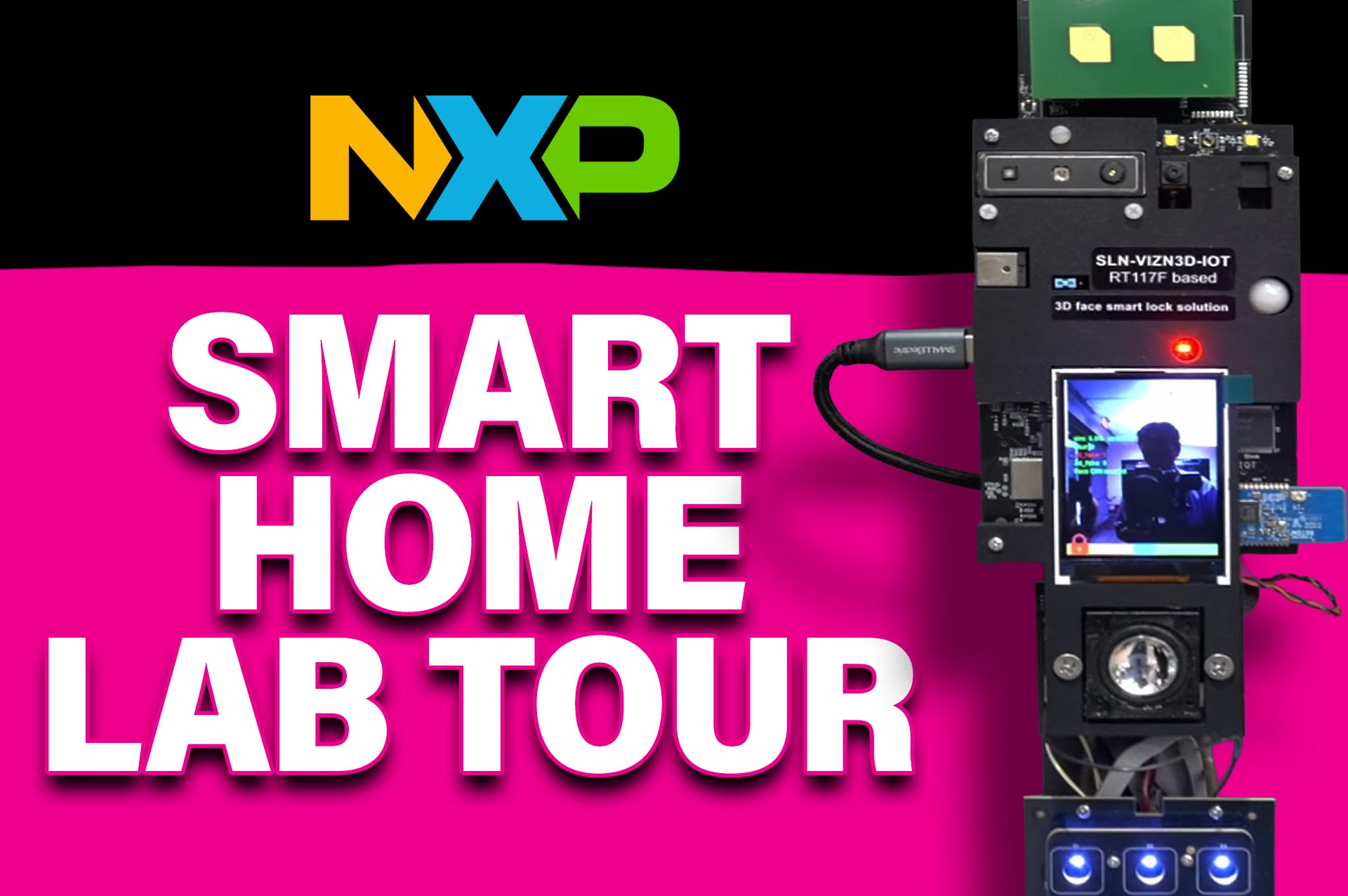
The smart door lock demo brings together multiple access methods, including keypad, fingerprint, Near Field Communication, UWB and facial recognition with depth perception. NXP also connects this to Aliro, the emerging standard for secure digital access.
This matters because smart access needs interoperability and security at the same time. A door lock has to work across devices and ecosystems while protecting credentials and resisting relay-style attacks. NXP’s approach combines secure elements, UWB ranging, NFC and wireless connectivity into a reference design that can help manufacturers reduce integration risk.
Local LLM and RAG for appliances
The kitchen demo shows a local Large Language Model with Retrieval-Augmented Generation. The use case is practical: an appliance can answer questions based on its own manuals and documentation, even when cloud connectivity is limited or unavailable.
The system combines automatic speech recognition, local language model inference, text-to-speech and decision logic. In an appliance, that could support user guidance, diagnostics, safety instructions or contextual support. The architecture also allows smaller nodes to make local decisions while a more capable processing unit handles higher-level reasoning.
Integrated audio processing
The media room demo focuses on immersive audio. Traditional audio/video receiver designs often use multiple boards and dedicated Digital Signal Processor components for decode, post-processing and system control. NXP’s i.MX-based approach shows how those functions can be consolidated into a more integrated processor platform.
That integration can reduce board complexity and help bring premium audio features such as Dolby Atmos and DTS into smaller or more cost-sensitive products, including soundbars and mid-tier home theatre systems. The demo also shows why media processing remains part of the wider smart home discussion. Audio, voice, connectivity and automation are increasingly linked in the same product architecture.
Why this matters for engineers
The NXP Smart Home Innovation Lab is valuable because it shows the smart home as a system. Local dashboards, Matter devices, UWB positioning, secure access, appliance intelligence and media processing all interact inside one environment.
For engineers building smart home, smart building or connected appliance products, the message is practical. Edge processing can reduce dependency on the cloud. Matter and Aliro
can improve interoperability. UWB can support precise spatial awareness. Local AI can make products more useful without sending every interaction off-device. Integrated processors can reduce hardware complexity while supporting richer user experiences.
Comments are closed.
Comments
No comments yet