
Published
26 January 2026
Written by Elliott Lee-Hearn
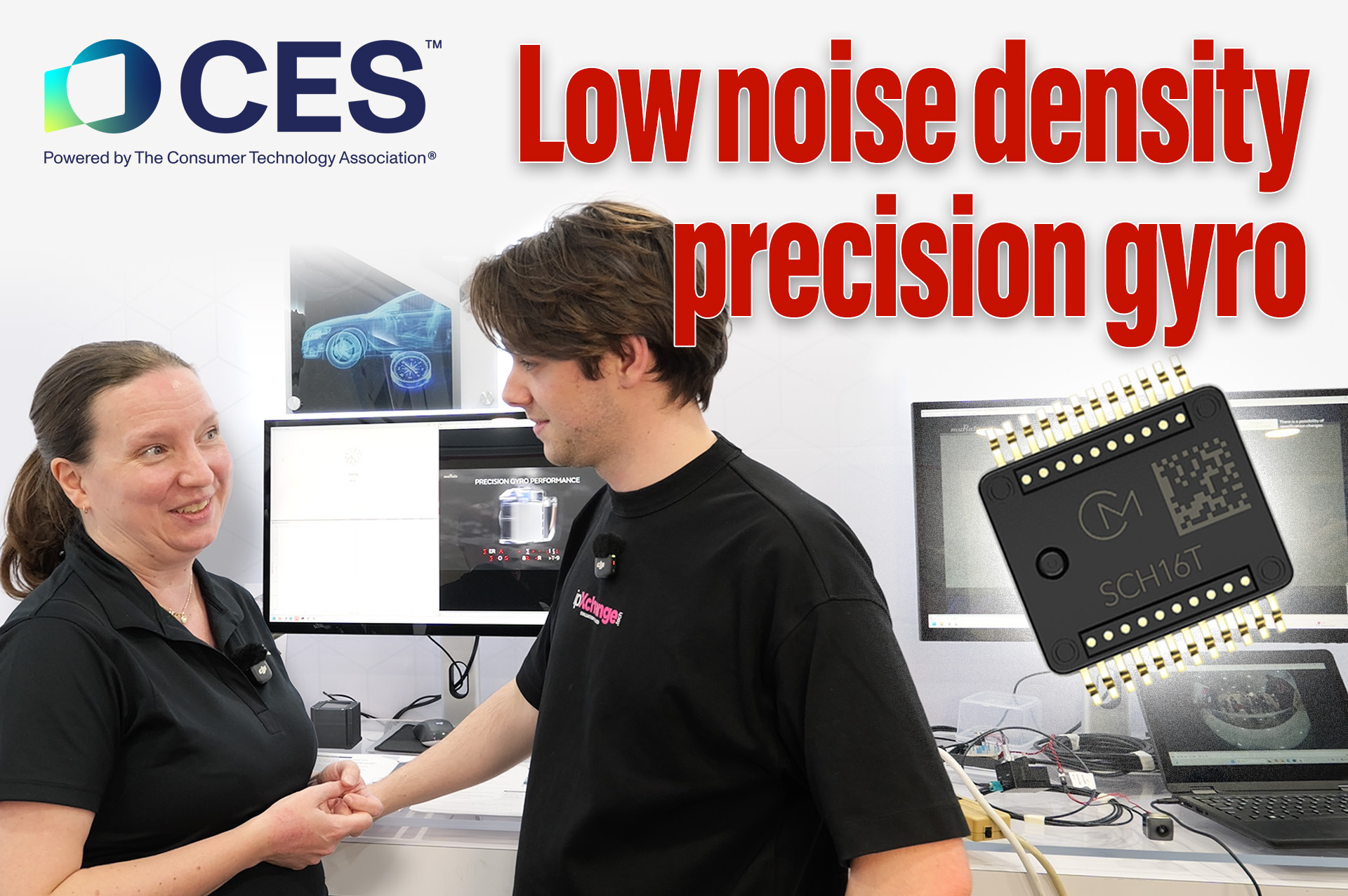
At CES 2026 in Las Vegas, ipXchange visited the Murata booth to take a closer look at one of the most technically impressive inertial sensors on display, the newly launched Murata SCH16T‑K20. This latest addition to Murata’s SCH16T IMU family is not a cosmetic update or minor iteration. It is a performance‑driven upgrade aimed squarely at engineers building motion‑critical systems where stability, noise performance and long‑term accuracy genuinely matter.
The SCH16T‑K20 is a fully integrated 6‑axis inertial measurement unit, combining a three‑axis accelerometer and a three‑axis gyroscope in a single compact MEMS package. While combined high-precision IMUs are common, Murata’s focus with the K20 has been on pushing real engineering performance rather than headline marketing metrics.
A new accelerometer architecture
The key upgrade in the SCH16T‑K20 is the accelerometer. Murata has introduced a new stable, low‑noise MEMS accelerometer design that uses a double differential measurement principle, a technique previously proven in Murata’s high‑performance SCA series sensors.
This architecture enables:
- Exceptionally stable offset behaviour over time
- High sensitivity stability across temperature ranges
- Very low noise density for precision motion sensing
For engineers, this translates directly into more reliable long‑term measurements, reduced drift, and consistent behaviour in real‑world operating environments where temperature variation and mechanical stress normally degrade sensor performance.
Built for motion‑critical applications
During the booth interview, Murata positioned the SCH16T‑K20 specifically for applications where accelerometer quality is just as important as gyroscope performance.
Target use cases include:
- Robotics motion control systems
- Camera and optical image stabilisation
- Precision navigation platforms
- Industrial motion tracking
- Stabilised platforms and control systems
These are applications where poor accelerometer stability introduces system‑level errors that cannot be corrected in software alone.
IMU performance that matters
The SCH16T‑K20 combines its new accelerometer with Murata’s already proven ultra‑low‑noise gyroscope technology. Key performance characteristics discussed during the showcase include:
- 6 degrees of freedom sensing (3‑axis acceleration + 3‑axis angular rate)
- Accelerometer noise density down to approximately 33 µg/√Hz
- Gyroscope bias instability around 0.3°/hour
- Stable performance over time and temperature
- Compact form factor for embedded system integration
Rather than chasing ultra‑low power marketing claims, Murata has clearly prioritised measurement quality, signal integrity and system reliability, making the SCH16T‑K20 a serious engineering component rather than a commodity sensor.
System integration and communication
From a system design perspective, the SCH16T‑K20 integrates cleanly into embedded platforms. It communicates via SPI, delivering high‑resolution inertial data for real‑time processing. Engineers receive:
- 3‑axis acceleration data
- 3‑axis angular rate data
- High‑precision motion feedback for control algorithms
This makes it suitable for tightly coupled control loops in robotics, stabilisation systems, navigation stacks and autonomous platforms.
Positioning within the SCH16T family
The SCH16T‑K20 builds on the earlier SCH16T‑K01, which established Murata’s reputation for ultra‑low‑noise gyroscope performance. The K20 expands this platform by delivering balanced high performance across both sensing domains, accelerometer and gyroscope, creating a more complete high-precision IMU solution.
Other family variants also address different application needs, such as wider measurement ranges for drone and aerial platform use cases, giving system designers a scalable IMU platform rather than a single fixed‑spec device.
A serious IMU for serious systems
What stands out with the Murata SCH16T‑K20 is its positioning. This is not a mass‑market consumer high-prevision IMU. It is designed for engineers building systems where motion accuracy is mission‑critical and sensor limitations directly affect product performance.
From robotics and automation to stabilised imaging and precision navigation, the SCH16T‑K20 represents a clear step forward in high‑stability, low‑noise inertial sensing.
As CES 2026 continues to be filled with AI headlines and software‑led innovation, it is refreshing to see fundamental hardware engineering advances like this that directly enable better real‑world systems.
🎥 Watch the full product showcase video on ipXchange
Comments are closed.
Comments
No comments yet