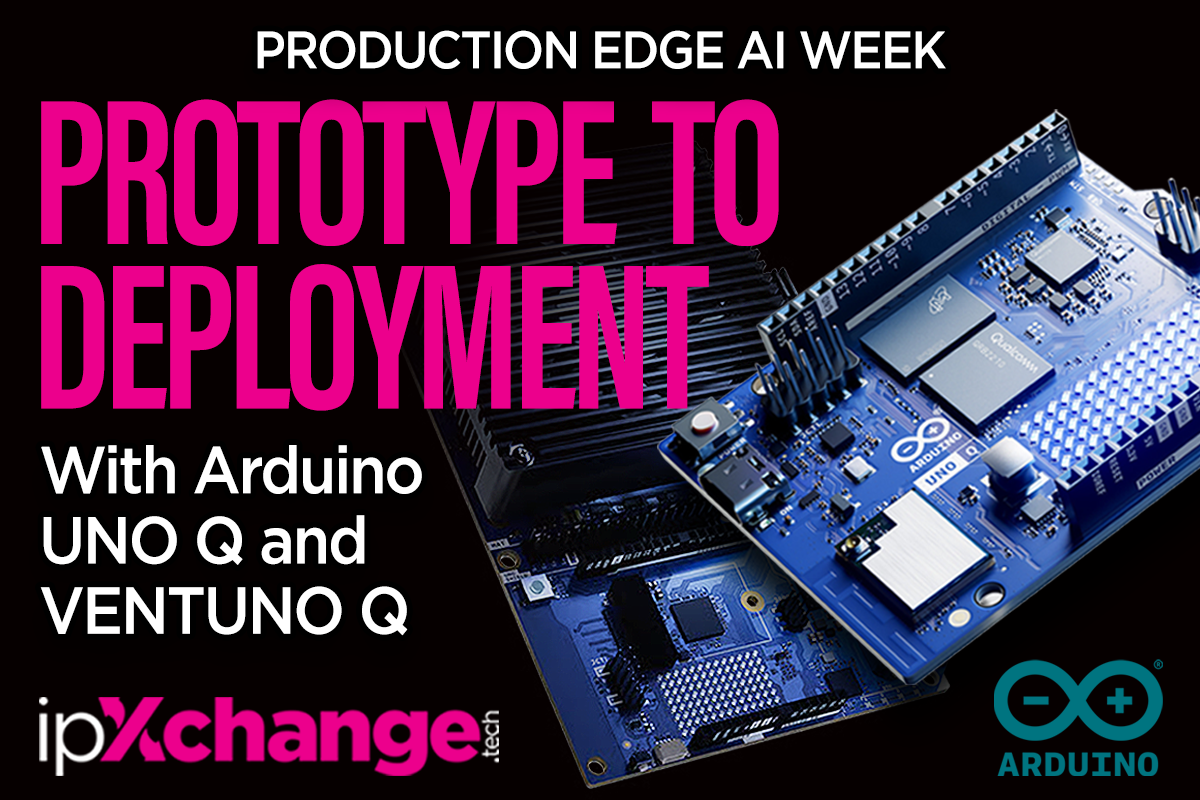

You’ve built the prototype, now it’s time for production. In this webinar we’ll look at what happens after you demonstrate an Edge AI application works on the bench, and the requirements for it to become an asset that can run reliably on a production line.
We’ll be discussing where the Arduino UNO Q belongs in the development and production journey, when a platform such as the VENTUNO Q becomes the better choice, and how the same workflows demonstrated in Arduino App Lab and Edge Impulse can be taken beyond a proof of concept and applied to real industrial operations.
A few demos on the UNO Q will cover visual anomaly detection and predictive maintenance, exploring how you can build proof of concepts more easily and quickly than before. From choosing the right hardware and operating system approach to containers, security, over-the-air (OTA) updates, deterministic control, and managing a model’s lifecycle, we’ll lay out the considerations that help you scale your prototypes.
What we’ll cover:
- The hardware, operating system and container considerations when moving towards production.
- Security, over-the-air (OTA) updates and model lifecycle management for deployed Edge AI systems.
- When to use the UNO Q, and when the VENTUNO Q is the better fit for a production application.
- Live visual anomaly detection on the UNO Q
- Live vibration anomaly detection using the UNO Q
Free