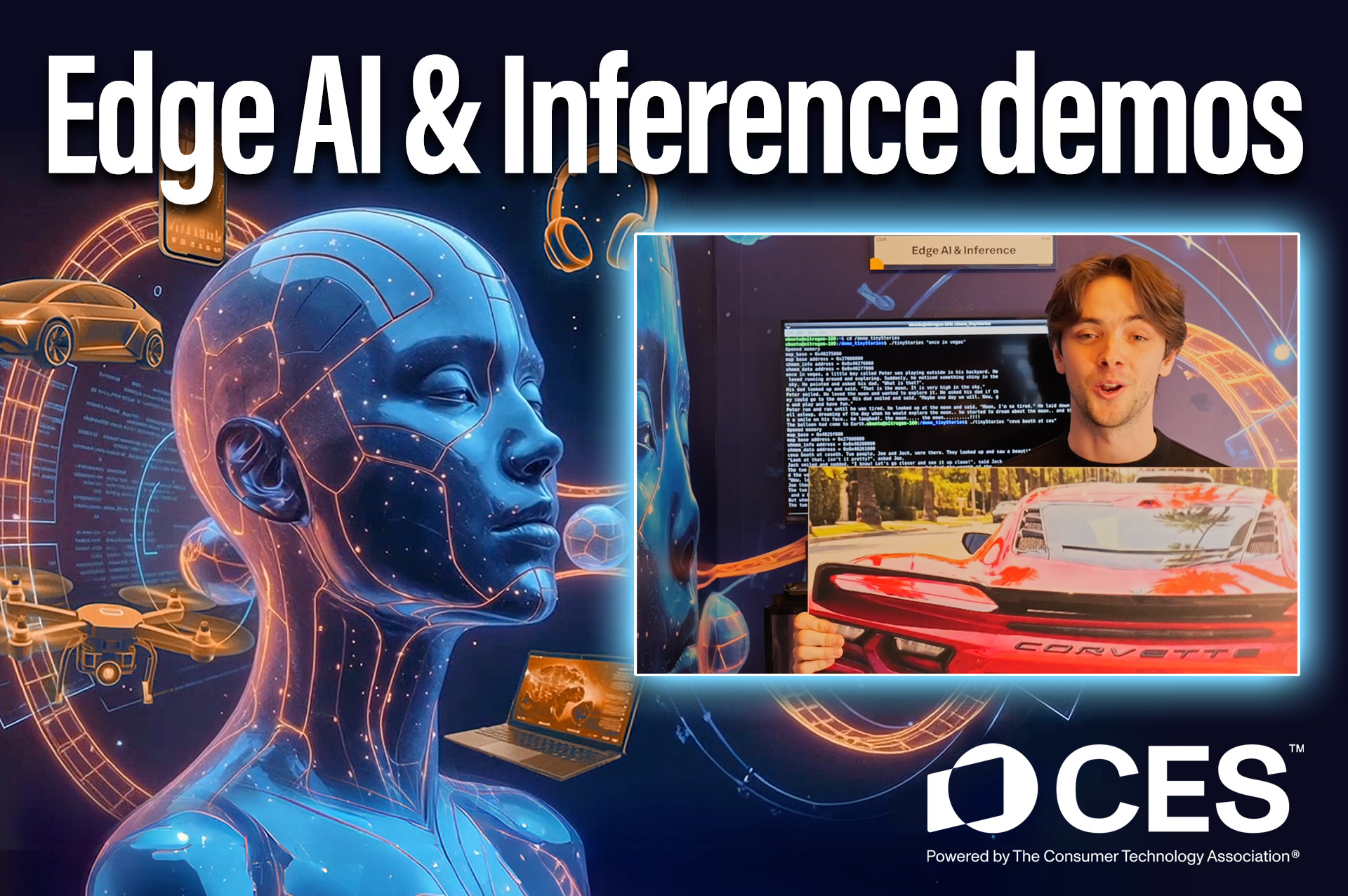

If you want to understand where edge AI inference is heading in 2026, you don’t need a keynote stage. You need a working demo.
At CES 2026, I stepped into a suite showcasing what modern edge silicon can really do. Not slides. Not synthetic benchmarks. Real models, running locally, making decisions in real time.
And that’s the key shift.
Demo 1: License Plate Recognition on the Edge
The first demo looked simple. A small model car. A printed number plate. A barrier that opens when the system recognises it.
But under the hood, this is what edge AI inference actually looks like in deployment.
A trained model from AIZIP was deployed onto CEVA‘s NPU platform running on FPGA hardware. The model detects:
- A vehicle
- A number plate
- The plate content
No cloud roundtrip.
No latency penalties.
No streaming video upstream.
That matters for applications like:
- Smart parking systems
- Access control
- Industrial automation
- Retail security
This is the practical layer of AI at the edge, where inference happens locally and deterministically.
From DSP to AI NPUs
What makes this platform interesting is its heritage.
Before NPUs became AI accelerators, they were DSP engines. Audio DSP. Vision DSP. Signal processing.
Now those same low-power optimisation principles are being applied to edge AI inference.
The portfolio shown ranges from around 200 GOPS up to 20 TOPS and beyond, depending on the workload. That means you can scale:
- Lightweight vision
- Audio AI
- Voice detection
- Anomaly detection
- Small language models
Without overprovisioning power.
For embedded engineers building battery-powered or thermally constrained systems, that matters more than raw TOPS marketing.
Inputs: Not Just Cameras
One of the most important clarifications during the demo was this:
Edge AI inference is not just about vision.
These NPUs can handle:
- Vision AI
- Audio AI
- Sensor fusion
- Predictive maintenance
- Small language models
That flexibility is critical in modern IoT and embedded AI systems, where workloads are mixed and evolving.
Demo 2: The Model Zoo That Engineers Actually Want
The second demo might have been even more important.
A ready-to-use model zoo platform. Pre-trained models. Pre-optimised. Deployable.
If you’ve ever taken a model from development to hardware, you know the pain:
- Quantisation
- Optimisation
- Compatibility issues
- Framework mismatches
The real bottleneck in edge AI inference is not model training. It is deployment.
Here, customers can access:
- Vision models
- Voice models
- TinyML variants
- Anomaly detection models
Already optimised for the target NPU.
Download. Benchmark. Deploy.
For engineers working with Edge AI, this dramatically shortens evaluation cycles.
Why This Matters
We are past the phase where AI on embedded systems is a novelty.
Now the differentiator is:
- Power efficiency
- Ecosystem maturity
- Deployment friction
- Scalable inference architecture
Edge AI inference is becoming infrastructure. Just like connectivity stacks and MCU ecosystems did before it.
The real advantage is not just silicon. It is:
- IP blocks
- Software toolchains
- Pre-trained models
- Deployment support
That full stack approach is what makes platforms like this viable in production systems.
Final Thoughts
CES always has noise.
But when you see real models running locally.
When you see inference happening without the cloud.
When you see optimisation baked into the architecture.
You realise edge AI inference is no longer experimental.
It’s deployable.
And that’s the shift that actually matters.
Comments are closed.
Comments
No comments yet