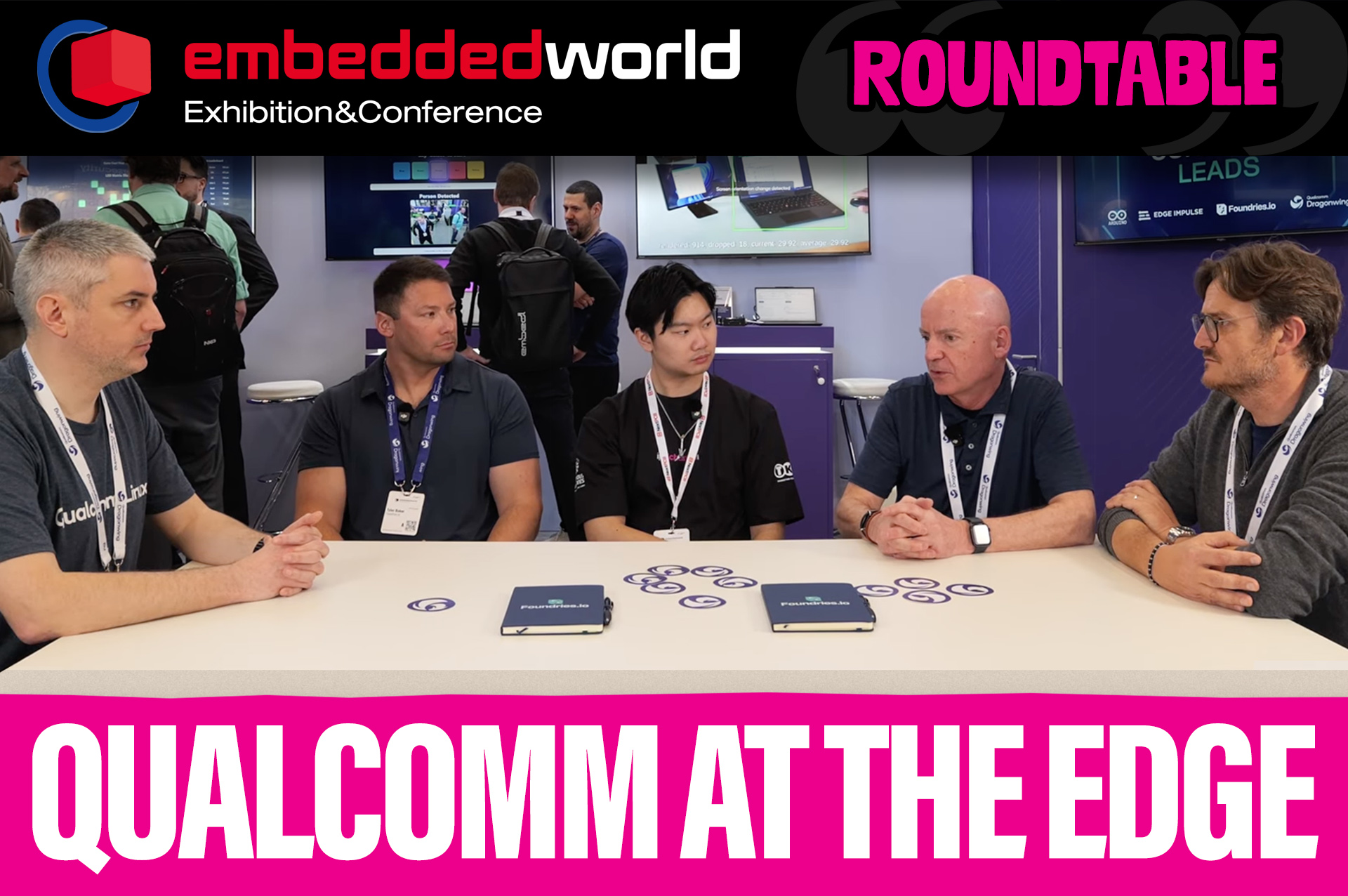

Qualcomm has long been associated with powerful silicon, but not always with easy access for smaller embedded teams. That is what seems to be changing. At Embedded World 2026, the message from Qualcomm’s wider ecosystem was clear: the company wants more developers building real products on its hardware, not just a small group of major original equipment manufacturers. That shift is showing up through open Linux work, the Arduino UNO Q entry point, the newly announced Arduino VENTUNO Q, and Foundries.io’s role in turning prototypes into maintainable products.
Why this matters now
The timing makes sense. The embedded and edge market is huge, but it is also fragmented. Many teams do not want to negotiate directly with a large silicon vendor just to start testing an idea. They want a board, documentation, a usable Linux environment, and a practical path into production. Qualcomm now has more of those pieces in place than it used to. Foundries.io says it was acquired by Qualcomm Innovation Center in March 2024, and Qualcomm announced its Arduino deal in October 2025. Taken together, that gives Qualcomm hardware, software, developer tooling and deployment infrastructure under one broader umbrella.
Arduino UNO Q is the developer entry point
The most immediate on-ramp is Arduino UNO Q. Arduino positions it as a dual-brain platform that combines a Qualcomm Dragonwing QRB2210 Linux-capable processor with an STM32U585 microcontroller for real-time control. It is available in 2GB and 4GB variants, includes eMMC storage, supports Debian Linux, and ships with Arduino App Lab. Arduino also states that schematics and gerbers are open. That combination matters because it lowers the amount of specialist knowledge needed to get started. Instead of beginning with a deeply custom Linux flow, developers can start with a board that feels familiar and still explore AI, vision, audio and richer Linux applications.
Debian first, Yocto later
One of the more interesting points in the discussion is the role of Debian. Qualcomm Linux is now publicly presented around both Yocto Project and Debian, while Arduino’s own documentation highlights Debian as the operating system on UNO Q. That matters because Debian gives developers a softer landing. Packages are easier to find, the user experience is more familiar, and the learning curve is much lower for teams that are new to embedded Linux. Yocto still matters for productisation, but Debian is a better way to get more engineers building sooner.
Foundries.io is the bridge to production
That is where Foundries.io comes in. Foundries.io’s Embedded World 2026 material shows UNO Q running Debian with FoundriesFactory and fioup for container application OTA and device management. The company positions its platform around secure lifecycle management for Linux devices, and it now sits inside the wider Qualcomm organisation while still supporting a broad hardware ecosystem. In practical terms, this helps close the gap between a successful proof of concept and a real shipped product. Developers can start simple, then add structured update, deployment and security workflows as the project becomes commercial.
VENTUNO Q shows where this is heading
The newly announced Arduino VENTUNO Q shows the higher end of the same strategy. Arduino and Qualcomm position it as a more powerful dual-brain board for AI, robotics and actuation, combining a Dragonwing IQ8 processor with an STM32H5 microcontroller. Arduino says it brings up to 40 dense TOPS, 16GB RAM and support for local large language models (LLMs), visual language models (VLMs) and edge AI workflows through App Lab. That gives developers a second rung on the ladder. Start with UNO Q if you want accessible Linux and mixed MCU plus MPU development. Move up to VENTUNO Q when the workload becomes more demanding.
Security is no longer optional
The Cyber Resilience Act makes this ecosystem story more important. The CRA entered into force on 10 December 2024. Its main provisions start applying on 11 December 2027, but Article 14 reporting obligations begin earlier on 11 September 2026. That means teams need better security processes before full enforcement arrives. A developer ecosystem that includes open Linux, structured update paths and lifecycle tooling is not just convenient now. It is becoming necessary.
The bigger picture is straightforward. Qualcomm is trying to make its hardware easier to access, easier to develop on and easier to scale. With Arduino, Debian and Foundries.io now clearly part of that story, it finally has a stronger answer for embedded developers who want more than just impressive silicon.
Comments are closed.
Comments
No comments yet